

How to Feel More Grounded During the Day When Your Mind Keeps Jumping
4 June 2026
Some days, your mind does not feel like it is gently moving from one thought to the next. It feels like it is jumping. From one task to another. From one worry to another. From one idea to another. From “I should do this” to “I forgot that” to “why am I suddenly thinking about something completely different?”
And even if nothing dramatic is happening, you can end up feeling scattered, restless, and disconnected from your own day. If you have ADHD, or if your brain tends to feel easily overwhelmed, this kind of mental restlessness can make daily life feel harder than it looks from the outside.
You may not need a stricter plan. You may need something softer: a few simple anchors that help you come back to the present moment, again and again.
Why Your Mind May Feel So Restless During the Day
When your brain keeps jumping, it can feel like you are failing at focus. But often, the problem is not that you are lazy or careless. Your brain may simply be trying to hold too much at once.
Tasks. Reminders. Emotions. Decisions. Open loops. Notifications. Expectations. Small things you do not want to forget. Big things you do not know how to start.
When everything stays floating in your mind, your brain keeps scanning for what matters next. That is exhausting. And the more scattered you feel, the harder it becomes to stay emotionally and mentally present.
Feeling Grounded Does Not Mean Feeling Perfectly Calm
A grounded day does not mean you feel peaceful all day long. It does not mean your mind never wanders. It does not mean you complete every task. It does not mean you suddenly become a perfectly organized person.
Feeling grounded simply means you have something to come back to. A focus. A rhythm. A small next step. A reminder that you do not have to solve the whole day at once.
Grounding is not about controlling your brain. It is about giving your brain support.
Start by Choosing One Main Focus
When your mind keeps jumping, one of the most helpful things you can do is choose one main focus for the day. Not ten goals. Not a full life reset. Not a perfect productivity plan.
Just one focus. Ask yourself: “What matters most today?”
Your answer can be practical, emotional, or very simple. For example:
- “I need to finish one important work task.”
- “I need to move gently through the day without burning out.”
- “I need to take care of the house a little.”
- “I need to stop avoiding one thing.”
- “I need to protect my energy.”
This gives your brain a center point. Even if the day gets messy, you know what you are trying to come back to.

Pick Fewer Priorities Than You Think You Should
A restless mind often wants to fix everything immediately. But too many priorities can make you feel even more scattered. Instead of asking, “What should I do today?” try asking: “What are the few things that would make today feel supported?”
Choose up to three priorities. Three is enough. And if your energy is low, one priority is enough too. The goal is not to prove that you can do everything. The goal is to create a day your brain can actually move through.
Break the Day Into Tiny Next Steps
When your mind is jumping, big tasks can feel impossible to enter. “Clean the house.” “Work on the project.” “Get organized.” “Catch up.” These are not really tasks. They are clouds. Your brain may not know where to begin, so it keeps bouncing away.
Try shrinking the task until it becomes visible. Instead of “clean the house,” try:
- clear the table
- put laundry in the basket
- wipe the counter
- take dishes to the sink
Instead of “work on the project,” try:
- open the document
- write the title
- list three ideas
- set a 10-minute timer
A tiny step is not silly. It is an entrance.
Use Time Anchors Instead of a Rigid Schedule
A full hourly schedule can feel comforting for some people, but overwhelming for others. If your brain resists rigid planning, try using time anchors instead.
A time anchor is a simple point in your day that gives you rhythm. For example:
- after breakfast, I check my main focus
- before lunch, I do one tiny task
- after school drop-off, I start my first priority
- mid-afternoon, I take a reset break
- after dinner, I prepare one thing for tomorrow
You are not trying to control every minute. You are giving your day a few places to land. This can help you feel less like you are floating from one thing to the next.
Plan Dopamine Breaks Before You Crash
If you have ADHD or an easily overwhelmed mind, breaks are not a reward for being productive. They are support. Your brain may need small moments of stimulation, pleasure, or relief to keep going.
A dopamine break can be simple:
- listen to one favorite song
- step outside for five minutes
- make a nice drink
- stretch
- send a voice note to someone
- do something with your hands
- take a short walk
- sit somewhere with natural light
The point is not to disappear into a three-hour scroll. The point is to give your nervous system and attention a small reset before you reach full overwhelm.

Have an “If Overwhelm Shows Up” Plan
Overwhelm is easier to handle when you do not have to invent a solution in the middle of it. Before the day gets too heavy, decide what you will do if overwhelm shows up.
Keep it simple. For example: “If I feel overwhelmed, I will stop, drink water, write down what is in my head, and choose one tiny next step.” Or: “If I freeze, I will lower the goal instead of quitting the whole day.”
This matters because overwhelmed brains often jump straight to shame. A plan gives you another option.
Give Your Mental Noise Somewhere to Go
Sometimes your mind keeps jumping because it is trying not to forget anything. So give those thoughts somewhere else to live.
A quick brain unload can help. Write down everything that is taking up space:
- tasks
- reminders
- worries
- random ideas
- things to decide
- things you are avoiding
- things you keep replaying
You do not have to organize it immediately. Just getting it out of your head can create more mental space.
Then you can choose what actually needs your attention today, and what can wait.
Check In With Your Energy, Not Just Your To-Do List
One reason daily planning can fail is that it ignores your actual capacity. You may write a plan for your ideal energy level, then feel guilty when your real energy cannot keep up.
Instead, ask: “How much energy do I actually have today?” Then plan from there. A low-energy day may need fewer tasks, more support, and smaller steps. A higher-energy day may allow for more focus or momentum.
This is not making excuses. It is working with reality. And when you work with reality, you are much more likely to keep moving.
A Gentle Tool to Help You Stay Anchored
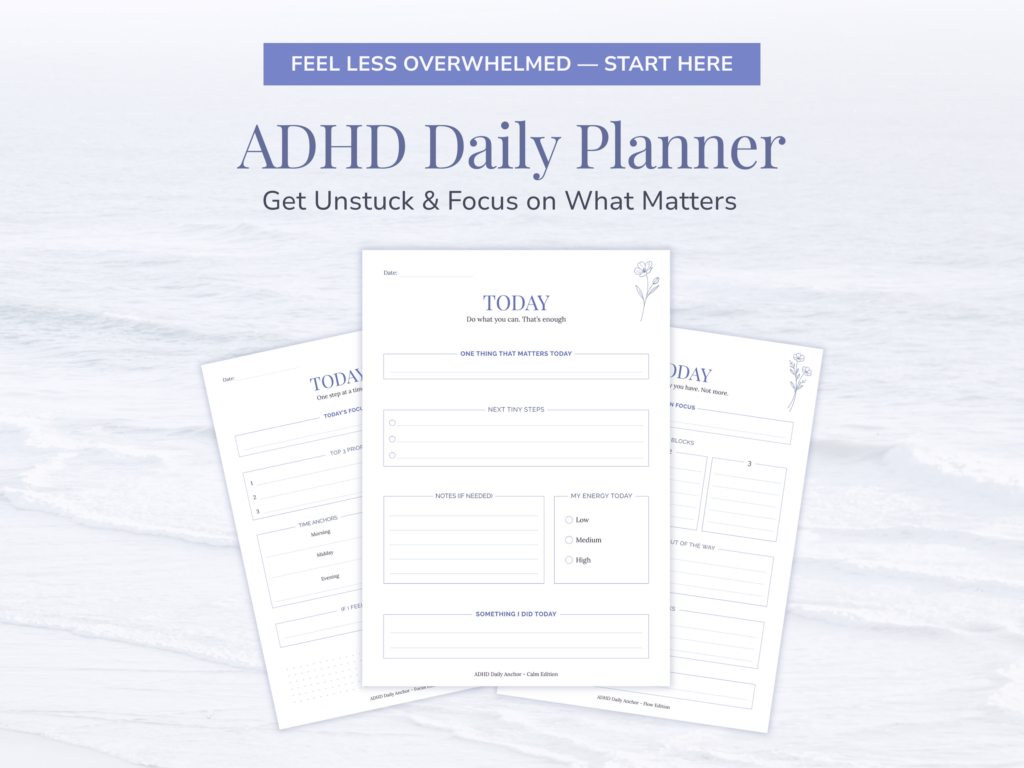
If your mind often feels scattered during the day, the ADHD Daily Anchor was created for exactly this kind of moment. It is not a rigid daily planner.
It is a simple daily page designed to help ADHD and overwhelmed minds feel more grounded, focused, and supported. The page helps you:
- choose one main focus for the day
- set up to three realistic priorities
- break tasks into tiny steps
- create supportive time anchors
- include dopamine breaks
- unload mental noise
- check in with your energy
- decide what to do if overwhelm shows up
It is meant to support your rhythm, not control it. You do not have to plan a perfect day. You just need a gentle place to come back to when your mind starts jumping again.
Final Thoughts
Feeling grounded during the day does not mean your brain becomes quiet forever. It means you have small ways to return to yourself.
A focus. A tiny step. A pause. A reset. A reminder that you can use the energy you have instead of fighting for the energy you wish you had.
You do not need to hold the whole day in your head. You can anchor yourself gently, one step at a time.