

10 Gentle Running Tips for Beginners Who Feel Discouraged Easily
5 June 2026
Starting running sounds simple. Put on your shoes. Go outside. Run. At least, that’s what people make it sound like. But when you are a complete beginner — and especially when you get discouraged easily — running can feel emotional before it even feels physical.
You may start with good intentions, then feel out of breath after two minutes. You may compare yourself to people who seem to run effortlessly. You may tell yourself, “I’m just not made for this.”
I know that feeling well. For a long time, I wanted to run. I liked the idea of being someone who runs. I wanted the fresh air, the clearer mind, the sense of pride after doing something good for myself.
But every time I tried, I started too hard, expected too much, felt terrible, and gave up.
What changed was not my body first. It was my approach. I stopped trying to become “a real runner” overnight. I stopped using running as a test I had to pass. I started seeing it as something I could build gently, one small run at a time.
And that changed everything. So if you want to start running but you feel easily discouraged, here are 10 gentle running tips to help you begin without pressure, shame, or impossible expectations.
1) Stop Trying to Prove You Are a Runner
One of the biggest mistakes beginners make is turning the first run into a personal exam. You go outside and suddenly your brain starts judging everything.
Am I too slow? Do I look ridiculous? Should I be able to run longer? Is this even running?
But your first runs are not here to prove anything. They are here to help your body and mind get used to something new.
You do not need to look like a runner to start. You do not need special confidence. You do not need to already be fit.
You become someone who runs by starting where you are. Not where you think you should be.
2) Begin With Walk/Run Intervals
If you remember one thing from this article, let it be this: Walking is not failure. For many beginners, alternating walking and running is the best way to start.
It helps your body adapt gradually. It makes the session feel less overwhelming. It gives your breathing time to settle. And it lowers the risk of finishing your first run thinking, “Never again.”
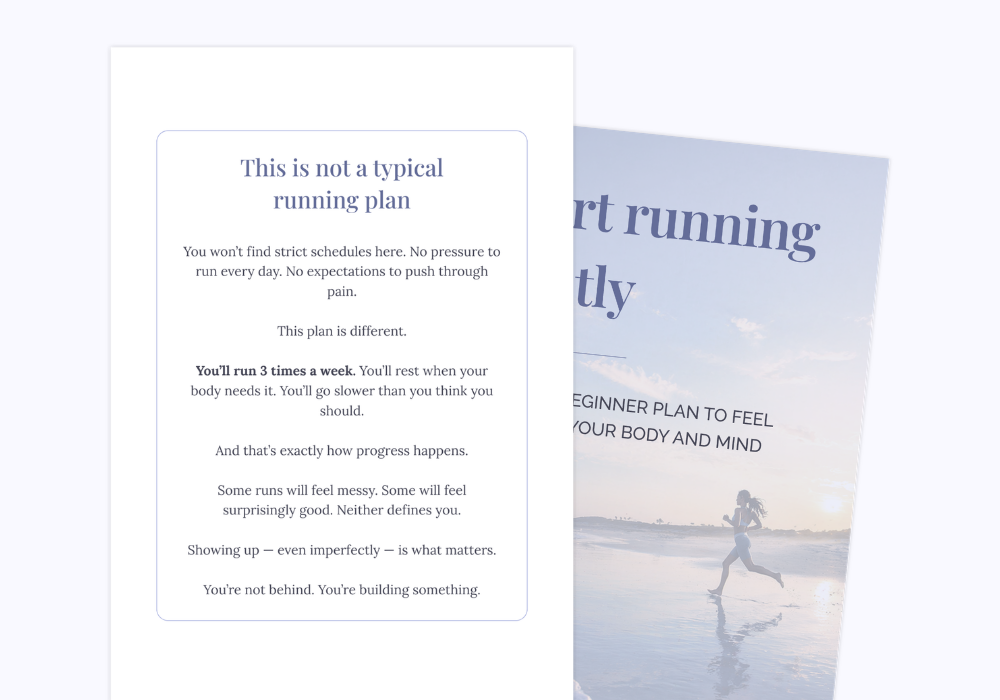
A gentle walk/run session might look like this:
- Walk for 5 minutes.
- Run for 1 minute.
- Walk for 2 minutes.
- Repeat several times.
- Finish with an easy walk.
That counts. You are still training. You are still building endurance. You are still becoming stronger.
The Start Running Gently 30-day plan is built around this exact idea: gentle run/walk sessions that help you progress step by step instead of throwing yourself into something too intense too soon.
3) Go Slower Than You Think You Should
Most beginners run too fast. Not because they are doing something wrong, but because they think running has to feel intense to count. It does not.
If you are gasping, panicking, or counting every second until it ends, slow down. Then slow down again. Your beginner pace may feel almost embarrassingly slow at first. That is okay. Slow is not a problem. Slow is how you build.
Running gently does not mean you are lazy. It means you are giving yourself a real chance to continue. And consistency matters much more than one dramatic, exhausting run.
4) Redefine What “A Good Run” Means
A good run is not always fast. A good run is not always long. A good run is not always one where you feel amazing.
Sometimes, a good run is the one you did even though you felt nervous. Sometimes, it is the run where you walked more than planned but still finished. Sometimes, it is the run where you listened to your body and stopped before pushing too far.
When you are a beginner, your goal is not to perform. Your goal is to build trust with yourself.
Every time you show up gently, you are teaching your brain: “I can do this without hurting myself, judging myself, or giving up on myself.” That is progress.

5) Don’t Wait to Feel Motivated
Motivation is lovely when it appears. But it is not a reliable plan. Some days, you will feel excited to run. Other days, your brain will find 47 reasons why today is not the right day.
That does not mean you are failing. It means you are human. Instead of waiting for motivation, make the start smaller. Tell yourself:
- I only have to put my shoes on.
- I only have to go outside.
- I only have to walk for five minutes.
- I can stop if I really need to.
Most of the time, starting is the hardest part. And once you begin, you may find that your body is more willing than your mind expected.
6) Let Running Support Your Mind, Not Just Your Body
For a long time, I thought running was mostly about fitness. Getting in shape. Building endurance. Becoming stronger. Maybe even proving something.
But when I started running during the end of my father’s life, it became something very different. It was not about performance. It was not about pace, distance, or becoming “good” at running. It was one of the only moments where I could step outside, breathe, move my body, and let my mind be somewhere else for a little while.
Some runs were slow. Some were messy. Some were more walking than running. But they gave me something I needed at the time: a little space. A little air. A little way to come back to myself when life felt heavy.
That is why I believe running can be much more than a fitness goal. It can be a way to clear your mind after a difficult day. A way to leave the house when everything feels too much. A way to feel your body again when you have been stuck in your head. A way to rebuild confidence after a season where you stopped trusting yourself.
That is also why a gentle beginner running plan can be so powerful. Not because it turns you into a different person in 30 days, but because it gives you a simple structure to return to yourself. One small run at a time.
7) Expect Some Runs to Feel Bad
This is important. Some runs will feel bad. Not dangerous. Not painful. But uncomfortable, messy, heavy, awkward, or mentally hard.
That does not mean you are not improving. It does not mean you should quit. It does not mean you are “not made for running.” It just means you are doing something new, and your body is adapting.
Beginner running is not a straight line. Some days you will feel surprisingly strong. Some days you will wonder why last week felt easier.
Both count. You do not need every run to feel good for running to be good for you.

8) Rest Without Guilt
Rest is not the opposite of progress. Rest is part of progress. Your body needs time to adapt, especially when you are new to running. If you try to run every day because you want results quickly, you may end up exhausted, sore, or discouraged.
A gentle rhythm is often much better.
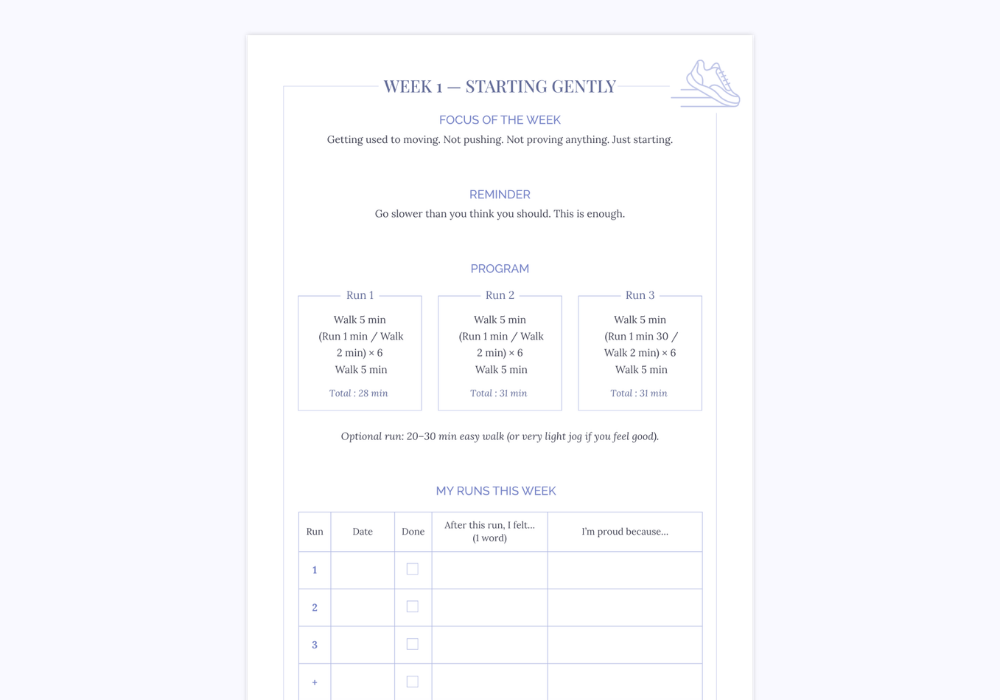
For example, the Start Running Gently plan uses 3 runs per week, with rest days built in. That kind of structure gives you enough consistency to build confidence, without making running feel like another impossible obligation.
You are not behind because you rest. You are building something sustainable.
9) Celebrate Small Wins
When you get discouraged easily, your brain may skip over your progress. You may finish a run and immediately think:
- It was slow.
- I walked too much.
- It was only 20 minutes.
- Other people can do more.
But what if you trained yourself to notice what went right? You went outside. You started. You moved your body. You kept going when it felt hard. You came back to yourself instead of giving up before trying.
That matters. Small wins are not childish. They are how you build evidence that you can keep promises to yourself.
One thing I learned is that progress is easy to miss when you tend to focus on what you haven’t achieved yet. That’s why the Start Running Gently guide includes reflection pages after each week and every run. They help you slow down, recognize your wins, and build evidence that you are moving forward — even when it doesn’t feel like it.
10) Remember: You Don’t Need to Be a Great Athlete to Be a Runner
You do not need to run a long distance. You do not need an impressive pace. You do not need expensive gear. You do not need to look confident. You do not need to love every second.
If you run, even slowly, even with walking breaks, even imperfectly, you are allowed to call yourself a runner.
Running is not reserved for naturally sporty people. It is accessible to almost everyone when you start gently, progress slowly, and stop treating your body like it has to prove something.
You are allowed to begin small. You are allowed to be slow. You are allowed to need breaks. You are allowed to build this in your own way.
A Gentle Way to Start Running
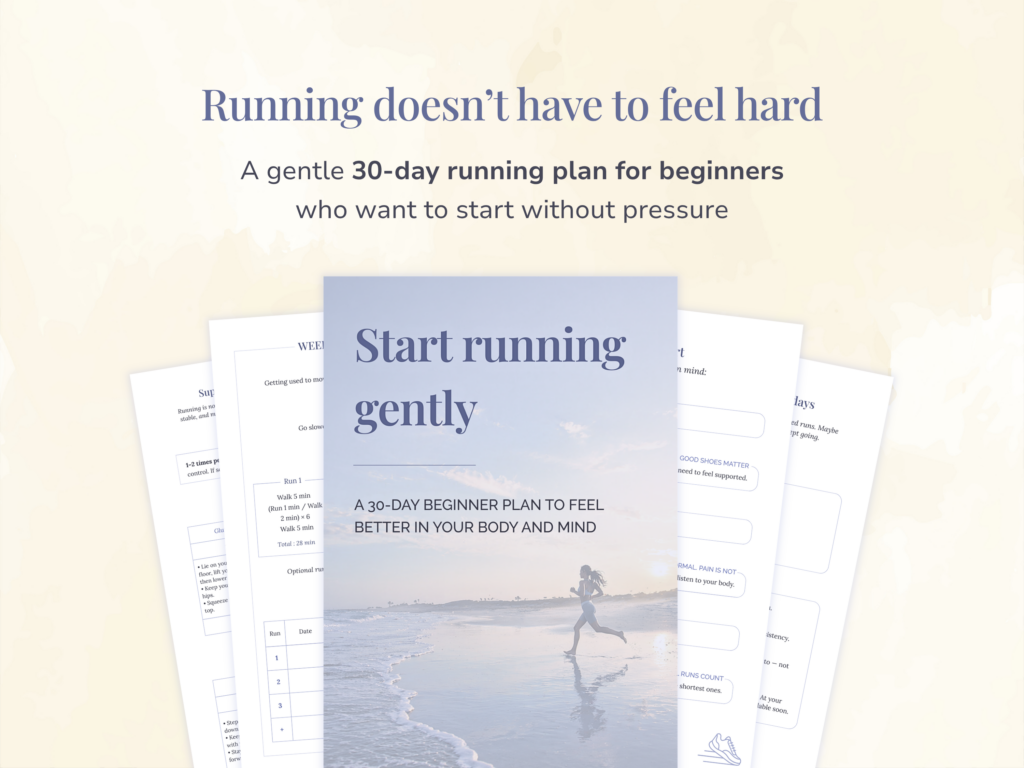
If you want to start running but you know you need something soft, realistic, and beginner-friendly, the Start Running Gently printable guide was created for exactly that.
It is a 30-day beginner running plan designed to help you feel better in your body and mind, without pressure, guilt, or intense performance goals.
Inside, you will find gentle run/walk sessions, supportive mindset prompts, reflection pages, a vision board, progress tracking, and simple strength exercises to help you feel stronger and more confident over time.
It is not about becoming a perfect runner. It is about starting in a way that feels possible. And sometimes, that is exactly what you need: not more pressure, but a clear and kind plan that helps you take the first step.
Final Thoughts
If running has always felt too hard, too intimidating, or too discouraging, maybe the problem was never you. Maybe the problem was the way you were trying to start.
You do not have to go all in. You do not have to run fast. You do not have to prove anything.
You can begin with walking. With one minute of running. With a slow pace. With imperfect consistency. With a plan that supports you instead of pushing you.
And little by little, you may realize something important: you are more capable than you thought. Not because you forced yourself. But because you finally gave yourself permission to start gently.