

Falling Behind Doesn’t Mean Starting Over: A Kinder Way to Resume Planning
16 February 2026
There’s a very specific moment that doesn’t get talked about much. You open your planner after days — sometimes weeks — of not touching it. You hesitate before turning the page.
And a quiet thought appears: I already failed. Not loudly. Not dramatically. Just enough to make you want to close it again.
For many people, falling behind in planning doesn’t feel like a small interruption. It feels like proof that something is wrong with them. Especially when the system itself looked perfect.
What’s really happening when you fall behind (and why it’s not your fault)
When a planning system stops working, most people assume the problem is consistency. But something I’ve noticed, in myself and in others, is that the real issue is often friction.
Many planning systems ask you to operate at your best every day — mentally clear, motivated, organized, predictable. Real life doesn’t work like that.
Energy fluctuates. Attention shifts. Life interrupts. And for ADHD or overwhelmed minds, the gap between the ideal system and real capacity becomes exhausting very quickly.
This doesn’t always look like chaos. Sometimes it looks like abandoning something you genuinely wanted to use. You didn’t stop caring. You ran out of mental space.
The belief that makes planning harder
After falling behind, a very logical reaction appears: start over. A new notebook. A new calendar. A new system. A blank page feels hopeful because it erases the evidence of stopping.
I know this pattern well. Each restart feels like a promise: this time I’ll do it properly.
But restarting from zero quietly reinforces the idea that continuity only counts if it’s perfect. And that creates pressure.
This is not about discipline. This is not about trying harder. It’s about the weight of systems that were never designed for irregular energy in the first place.

The shift that makes planning feel possible again
What surprised me over time was how much easier planning became when I stopped trying to build the “perfect” system. Minimalism changed everything.
Not aesthetic minimalism — functional minimalism. A system simple enough to survive real life.
Complex planning structures often look supportive, especially those marketed for ADHD minds. But many of them require constant interaction, multiple trackers, long-term projections, and dozens of pages to maintain.
For overwhelmed brains, complexity quickly becomes noise. A simpler structure does something different: it removes the penalty for leaving.
You’re allowed to step away — even for several days — and come back without needing to reset anything.
That small change matters more than motivation ever did. Because planning stops being a performance and becomes orientation again.
How to resume planning gently in real life
Resuming doesn’t require catching up. You don’t need to fill missed pages. You don’t need to explain the gap. You don’t need a fresh start.
You can simply open where you are today. For many people, this isn’t laziness. It’s recovery from overwhelm.
Something shifted for me when I began using planning day by day instead of week by week. When I returned after a pause, I no longer felt inadequate. The system still fit me.
That feeling is important. Planning works best when it adapts to you — not when you constantly adapt to it. If reopening your planner feels neutral instead of heavy, you’re probably closer to a sustainable rhythm than you think.

If you want support applying this
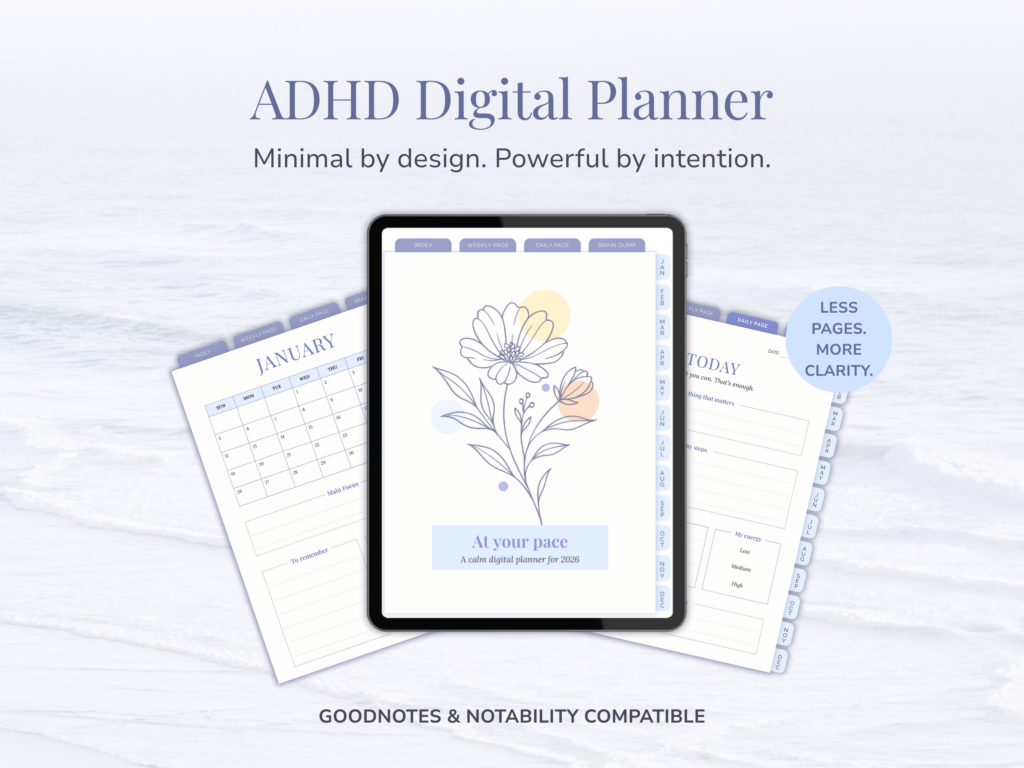
I created the ADHD Digital Planner – At Your Pace because I was tired of seeing planners labeled “ADHD-friendly” that were actually overwhelming — filled with hundreds of pages and complex systems that required constant effort to maintain.
ADHD minds don’t need more structure. They need lighter structure.
This planner is intentionally simple. Monthly, weekly, and daily pages exist only when you need them. You can skip days, duplicate pages, pause for weeks, and return without restarting anything.
There’s no right way to use it. It’s not meant to fix consistency. It’s meant to make returning easier.
I built it as a place to land when planning feels heavy — the kind of system I needed myself. If this approach resonates, you can explore it quietly and see if it feels supportive for you too.
A softer way to see falling behind
Falling behind doesn’t mean starting over. Often, it simply means you were living your life. You’re allowed to pause without losing progress. You’re allowed to resume without proving anything.
Planning isn’t a test you pass or fail. It’s just a way to find your place again — whenever you’re ready to look. And you don’t need a perfect streak to begin today.