
You Don’t Have to Move On: Rethinking Healing After Loss
30 January 2026
At some point after a loss, the message appears — sometimes gently, sometimes not. “You’ll move on.” “Time will heal.” “Try to focus on the future.”
Even when these words are meant kindly, they can land heavily. As if healing after loss were something you should complete. As if staying connected to what you lost meant you were doing it wrong.
If you feel pressure to “move on” before you’re ready, there’s nothing wrong with you. You may simply be needing something very different.
What’s really happening when you’re told to move on
Healing after loss is often misunderstood. It’s treated like a task with a finish line — something to work through and leave behind. But grief doesn’t work that way.
Loss changes you. It reshapes your inner landscape, your sense of safety, your relationship to the world. Wanting space to acknowledge that isn’t resistance — it’s honesty.
When people rush you toward “moving on,” what they often miss is that grief needs recognition before resolution. Without that recognition, pain doesn’t disappear — it just becomes quieter and heavier.
The pressure to heal quickly can add a second layer of suffering: the feeling that you’re failing at grief itself.
The shift: healing doesn’t mean leaving the pain behind
A gentler understanding of healing after loss begins with this shift: Healing doesn’t require forgetting, replacing, or closing the door.
It’s not about erasing pain. It’s about learning how to live with what happened, in a way that feels more breathable over time. For many people, healing looks like:
- allowing memories to exist without apology
- giving emotions room without needing to explain them
- staying connected to what mattered, in a new form
Moving forward doesn’t mean moving away. It means making space for what you carry, without being consumed by it.

How to create space for grief without pressure
If “moving on” feels impossible or wrong, that may be because you’re not meant to move on — you’re meant to slow down and listen. Here are a few gentler ways to support healing after loss:
1. Let your experience exist without a timeline.
There is no correct pace for grief. Healing happens when it’s allowed to unfold, not when it’s forced.
2. Give words to what’s present — even imperfectly.
You don’t need the right language. Honest, unfinished words are often enough to ease internal tension.
3. Create contained moments for expression.
Grief can feel overwhelming when it has no boundaries. Small, intentional spaces can make it safer to touch.
Healing doesn’t ask you to be ready. It asks you to be present.
If you want support applying this
If writing feels like a gentle way to stay present with what you’re carrying, having a supportive container can help.
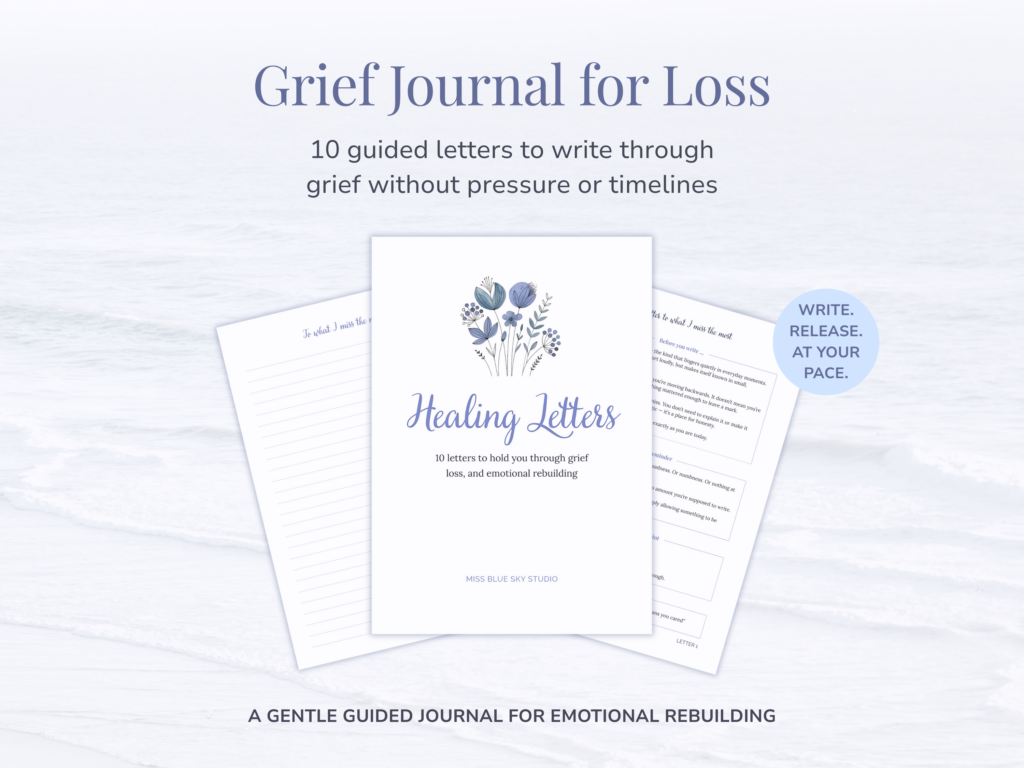
Healing Letters is a quiet writing kit designed to accompany healing after loss without pushing you toward “moving on.” It offers ten guided letters you can approach in any order, each with soft prompts and space to write — or simply sit — with what’s there.
There’s no pace to follow and nothing to complete. You can choose the letter that feels right in the moment and leave the rest. The intention isn’t to fix the pain, but to allow it to exist with more tenderness and less isolation.
If you’re looking for a gentle way to acknowledge your experience and listen to yourself, this writing practice can support you — imperfectly, and at your own rhythm.
A final reminder
Healing after loss isn’t about closing a chapter. It’s about learning how to carry the story differently. You don’t have to move on to heal. Sometimes, staying with what matters — gently — is already a form of healing