

How a Simple Daily Journal Can Reduce Mental Overload Over Time
4 March 2026
Mental overload rarely arrives all at once. It builds quietly. A thought you didn’t process. A worry you pushed aside. A responsibility you kept in your head instead of releasing.
Until one day, your mind feels full — and you don’t even know why. You feel pressure in your chest. Breathing feels shallow. Everything seems heavier than it should be. You’re tired, overwhelmed, slightly lost, and unsure where to start.
Many people try to fix this by thinking harder. But mental overload is not solved inside the mind alone. Sometimes, it needs somewhere else to go.
What Mental Overload Actually Feels Like
For me, mental overload wasn’t dramatic or obvious. It felt like constant internal tension:
- thoughts looping without resolution
- difficulty breathing deeply
- emotional fatigue without a clear reason
- stress that stayed even when nothing urgent was happening.
I tried reassuring myself. I tried breathing exercises. I told myself to put things into perspective.
And while those things helped a little, the relief never lasted long. Because the thoughts were still there — just temporarily quiet. Nothing had actually been released.
Why Unprocessed Thoughts Keep Accumulating
Our brains were never meant to store everything indefinitely. Yet many of us carry:
- unfinished tasks
- small worries
- ideas
- expectations
- emotions we didn’t fully acknowledge.
Each one takes a tiny amount of mental space. Individually, they seem manageable. Together, they create saturation. Mental overload is often not about having too much to do — but about having too much unexpressed.

The Moment I Realized Journaling Was Working
When I started journaling, I didn’t expect big changes. But I noticed something quickly. My mornings felt smoother.
Instead of starting the day already tense, I felt lighter — as if my mind had somewhere safe to land before the day began.
There was a quiet sense of direction. Not a perfect plan. Not sudden productivity. Just clarity.
And that alone changed how the day unfolded.
Why a 5-Minute Journal Makes the Difference
One of the biggest barriers to journaling is simple: “I don’t have time.” Long journaling sessions can feel intimidating, especially when you already feel overwhelmed.
That’s why a 5-minute format matters. It removes the negotiation. You don’t need motivation. You don’t need a perfect mindset. You don’t need an empty schedule.
Five minutes is short enough that your brain stops resisting. There’s no excuse that it will take too long or steal time from more “important” things. And paradoxically, consistency becomes possible precisely because the practice is small.

How Daily Writing Reduces Mental Overload Over Time
Journaling doesn’t erase stress instantly. What it does is prevent accumulation. Each day, you release a little:
- a thought clarified
- an emotion acknowledged
- a focus chosen
- gratitude noticed.
Over days and weeks, the effect becomes noticeable. You feel relieved. Soothed. Calmer. More focused. Mentally lighter — often faster than expected. Not because life changed overnight, but because your mind stopped carrying everything alone.
A Gentle Starting Point: The 5-Minute Daily Gratitude Journal
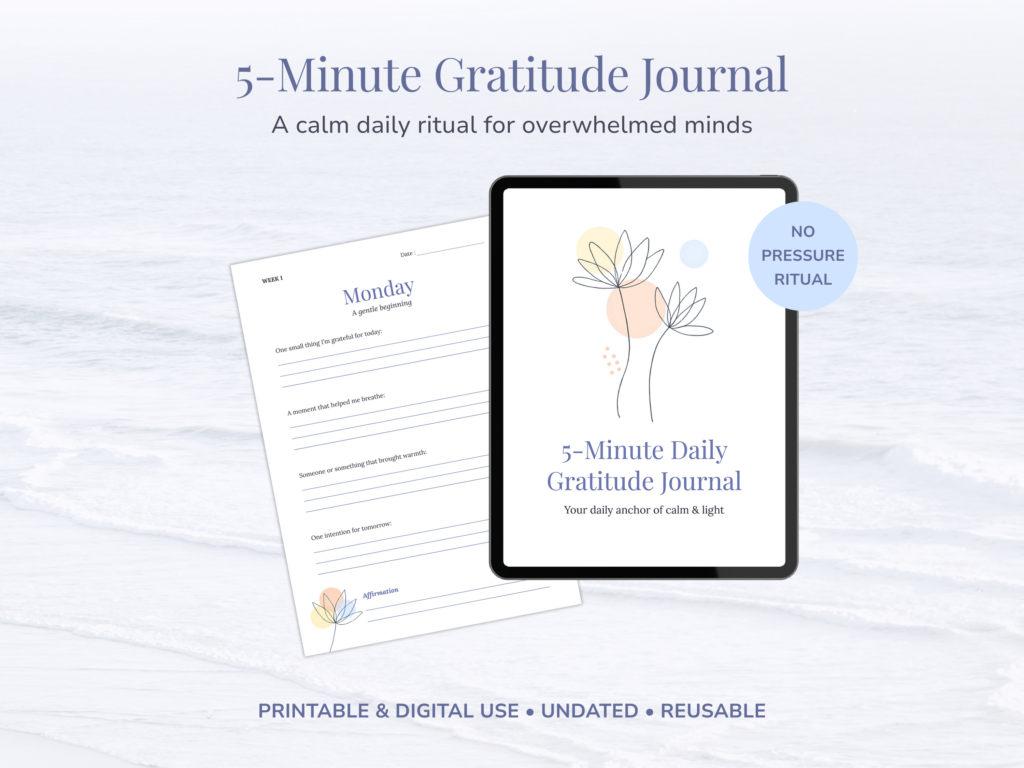
The 5-Minute Daily Gratitude Journal was created as a small daily anchor — not to analyze your thoughts or fix your life, but to offer your mind a quiet place to land.
Instead of asking you to write long reflections, it guides your attention toward small moments of support: something that helped you breathe, a tiny win, a moment of warmth, or one gentle intention for tomorrow.
These simple prompts may seem small, but over time they change something important. Your brain stops focusing only on pressure and unfinished tasks. It begins to notice what feels steady, supportive, and meaningful.
And little by little, mental overload softens — not because everything disappears, but because your inner world feels calmer and less crowded. Just five minutes a day can become a gentle reset, helping you start each morning with more clarity, softness, and emotional space.
Small Moments, Repeated Gently, Change More Than We Think
Mental overload rarely disappears because we finally become more organized or more productive. Often, it softens when we give our mind small, regular moments of pause.
Moments where nothing needs to be solved. Moments where attention shifts away from pressure and back toward what feels supportive, steady, or quietly good.
A simple daily journal may seem insignificant at first. But when you spend a few minutes each day noticing a breath, a small win, or a moment of warmth, something changes over time.
Your mind feels less crowded. Your days begin with more softness. And clarity returns, not through effort, but through gentle consistency. Sometimes calm doesn’t come from doing more or thinking harder. Sometimes it begins with simply noticing what is already helping you carry the day.