

How to Separate What You Feel From What’s Actually Happening
12 June 2026
Some days, your mind does not just feel full. It feels convincing. A small comment suddenly means everyone is disappointed in you. One unfinished task becomes proof that you are failing. A stressful moment turns into a whole story about how nothing is working.
And in that moment, it can feel completely true. That is what makes emotional overwhelm so difficult. Your feelings are real. But they are not always the full story.
When Feelings Start Sounding Like Facts
When you are stressed, tired, anxious, or overwhelmed, your brain can start mixing two things together: What happened. And what you feel about what happened.
For example:
- Fact: “I did not finish everything today.”
- Feeling: “I am behind.”
- Story: “I never get anything done.”
The feeling may be understandable. But the story may not be fair. And when feelings start sounding like facts, everything feels heavier than it needs to.
Why This Happens
Your brain is not trying to sabotage you. It is trying to make sense of the moment. When something feels emotionally intense, your mind searches for meaning. It wants to understand why you feel bad. So it builds a story quickly.
Sometimes that story is helpful. Sometimes it is not. Especially on overwhelming days, your brain may jump to conclusions before you have had a chance to breathe.
That is why the first step is not to “think positive.” The first step is to slow the story down.

The Simple Question That Creates Space
When your mind feels too loud, ask yourself: “What are the facts here?” Not the fears. Not the assumptions. Not the worst-case scenario. Just the facts.
Try writing them down in the most neutral way possible:
- “I received a short message.”
- “I have three tasks unfinished.”
- “I feel tense in my body.”
- “I made a mistake.”
- “I do not know what the other person is thinking.”
This does not erase your feelings. It simply gives them a clearer place to land.
Then Name What You Feel
After the facts, ask: “What am I feeling about this?” Maybe you feel embarrassed. Disappointed. Rejected. Afraid. Overstimulated. Angry. Tired.
Naming the feeling matters because it helps you stop treating it like a permanent truth:
- “I feel like I failed” is not the same as “I failed.”
- “I feel behind” is not the same as “I am hopelessly behind.”
- “I feel unsafe” is not always the same as “I am in danger.”
Your feelings deserve care. But they do not have to make every decision for you.
Notice The Story Your Brain Added
This is the part many people skip. After the facts and the feelings, look at the story. What did your brain add?
Maybe it added:
- “I always ruin things.”
- “She must be mad at me.”
- “I will never catch up.”
- “I should have handled this better.”
- “Everyone else manages life better than I do.”
These thoughts can feel automatic. But once they are written down, you can look at them with more distance. You do not have to fight them. You can simply ask: Is this a fact, or is this a story my stress created? That one question can soften everything.

Focus On What You Can Actually Do
Once you separate facts from feelings, the next step becomes easier. You can ask: What is still in my control?
- Maybe you cannot control someone else’s reaction. But you can send a calm reply.
- Maybe you cannot redo the whole day. But you can choose one small task.
- Maybe you cannot fix every problem tonight.
But you can drink water, breathe, write things down, and come back to it tomorrow.
This is not about ignoring reality. It is about returning to what is manageable.
A Gentle Tool For Heavy Days
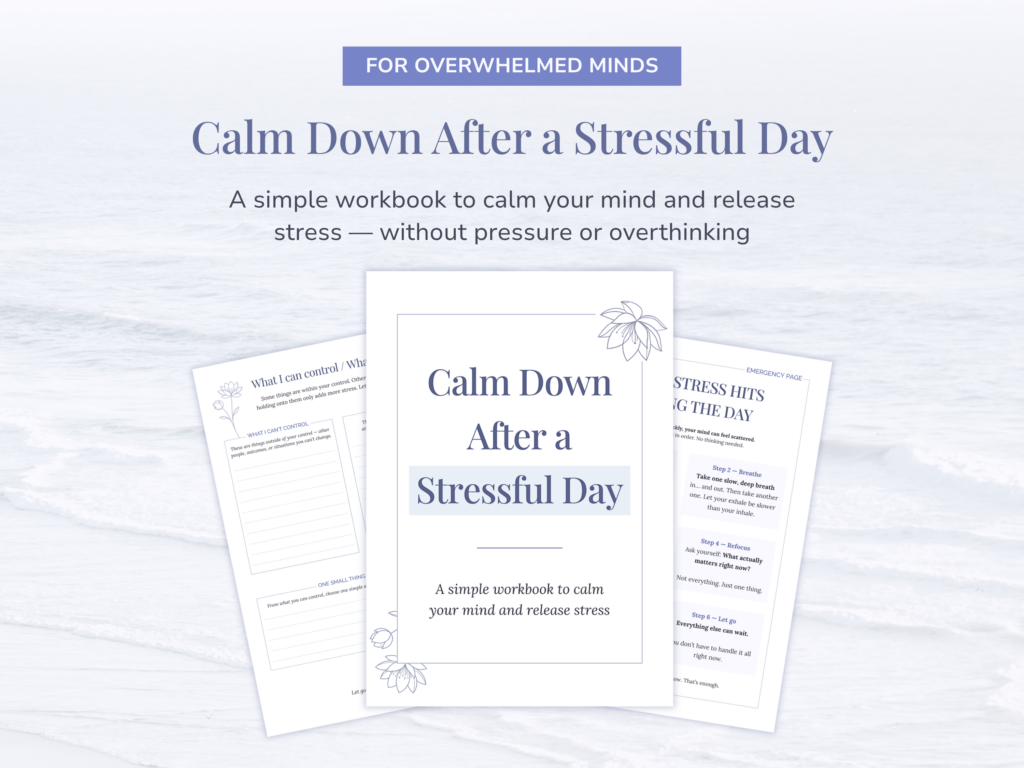
This is one of the reasons I created the Stress Relief Workbook. It gives you a calm space to pause when your mind feels too full. Instead of pushing you to fix everything, the workbook guides you through simple pages to:
- Let your thoughts out without pressure
- Separate facts from feelings
- Notice what is and is not in your control
- Release what feels heavy
- Choose one small next step
It also includes calming exercises for your body, like breathing, grounding, and gentle tension release, because stress does not only live in your thoughts.
Sometimes your mind needs clarity. Sometimes your body needs safety. Often, you need both.
Final Thoughts
You do not need to distrust your feelings. You just need to remember that they are signals, not always conclusions. A feeling can tell you that something matters. It can tell you that you are tired. It can tell you that you need care, space, rest, or support. But it does not always tell you the whole truth.
So the next time everything feels bigger than it is, pause. Ask what actually happened. Name what you feel. Notice the story. Then choose one small thing you can do next.
You do not have to solve everything at once. You only need enough clarity to breathe again.