

The Hidden Reason Your Goals Feel Overwhelming (It’s Not Laziness)
3 April 2026
At first, it always feels exciting. A new goal. A fresh start. This time, you’re motivated. You’re ready. And for a moment, it works.
Then something shifts. You start to realize how much there is to do. How long it’s going to take. How far you still are from the result.
And suddenly, everything feels heavy. “This is too much. I’m not going to make it.”
So you stop. And a few days later, you move on to something new. Not because you don’t care. Not because you’re lazy. But because something in the way your goal is structured is working against you.
The Real Problem: Your Brain Is Facing Something Too Big
Most goals are built like this:
- vague
- far away
- outcome-focused
“Get in shape”. “Grow my business”. “Get organized”.
The problem? Your brain can’t do anything with that. There’s no clear starting point. No visible progress. No sense of completion. Just a big, blurry mountain.
And for an ADHD or overwhelmed mind, that creates instant resistance. Not because you don’t want it. But because your brain doesn’t know how to enter it.
Why You Keep Starting (and Stopping)
This is where the cycle begins: you start with high motivation → you face the real workload → you feel overwhelmed → you stop → you start something new.
It’s not inconsistency. It’s a mismatch between your brain and the way your goals are designed.
When a goal feels too big, your brain protects you by pushing you away from it. That’s not failure. That’s regulation.

What Actually Reduces Overwhelm
Overwhelm doesn’t come from effort. It comes from uncertainty + scale.
When your brain sees:
- too many steps
- unclear steps
- or steps that feel too big
It freezes.
But when things become smaller, clearer, visible, something shifts. You don’t need more motivation. You need a way to make the goal feel approachable.
The Shift: From Big Goals to Tiny Steps
What changed everything for me wasn’t choosing better goals. It was changing how I approached them.
Instead of focusing on big milestones, I started breaking everything down into mini steps. Not “what do I need to achieve?” but: “What is the smallest step I can take right now?”
Not impressive. Not optimal. Just doable. And that changes everything.
Because when a step feels small enough, your brain stops resisting. You start. And once you start, momentum takes over.

Why Tiny Steps Work So Well
Tiny steps do three things your brain needs:
- They reduce pressure
- They create quick wins
- They make progress visible
Instead of facing a huge goal, you’re just completing one small action. And then another. And another.
That’s how you move forward without feeling crushed by the weight of the goal.
A Simpler Way to Move Toward Your Goals
You don’t need to push harder. You need to make your goals easier to approach.
That means:
- breaking them into clear milestones
- turning each milestone into small actions
- focusing on one step at a time
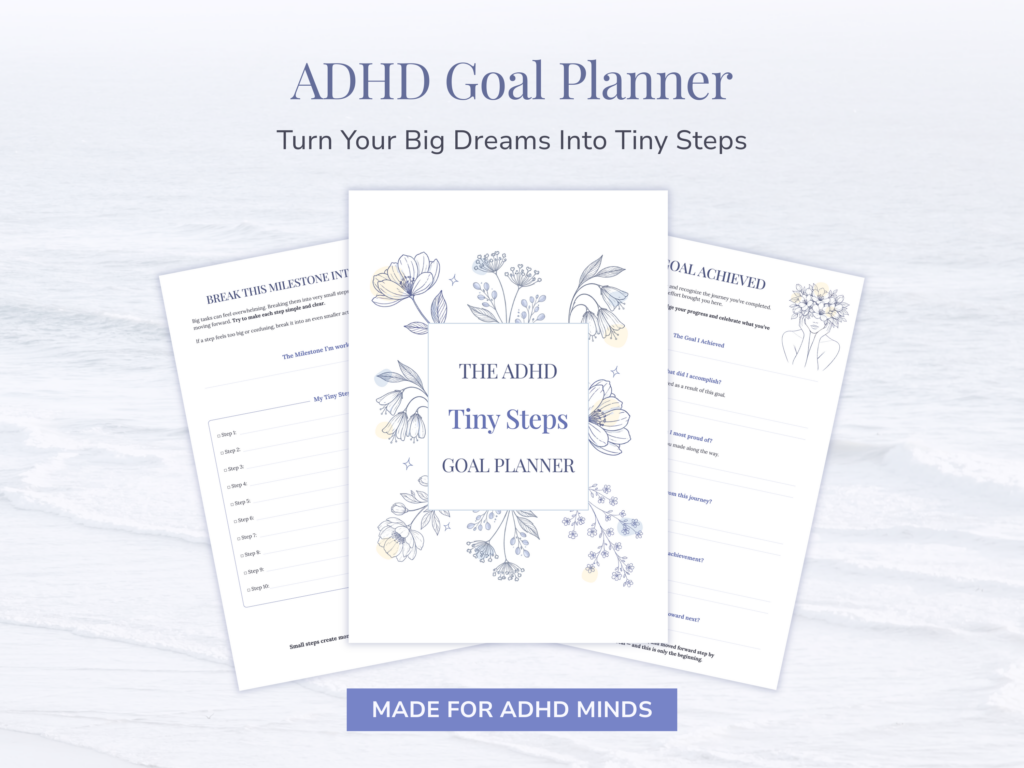
That’s exactly what I designed the ADHD Goal Planner – Tiny Steps System for.
Instead of overwhelming you with big goals, it guides you step by step:
- define your goal in a clear, simple way
- break it down into realistic milestones
- turn those milestones into tiny, actionable steps
- track your progress in a visible, motivating way
Each page is designed to help you move forward without pressure, so your goal stops feeling like a mountain — and starts feeling like a path.
A Gentle Reminder
You’re not lazy. You’re not inconsistent. You’ve just been trying to carry goals that were too heavy, too vague, too far away.
You don’t need to do more. You don’t need to push harder. You just need to make things smaller.
One step. Then another. That’s how you move forward.