

Why ADHD Days Fall Apart Without a Clear Anchor
7 February 2026
Some days start with motivation. You wake up ready to do things, with energy and good intentions. And yet, by mid-day, everything feels scattered. You’ve touched many tasks, finished few, and your mind feels tired in a way that doesn’t match what you actually did.
If this keeps happening, the issue isn’t motivation. It’s the absence of a clear ADHD daily focus.
What’s really happening (and why it’s not your fault)
ADHD days don’t fall apart because you don’t care enough. They fall apart because, without a clear anchor, your attention has nowhere to settle.
ADHD brains are highly responsive to what’s around them. Notifications, ideas, unfinished tasks, and shifting energy levels constantly pull your focus in new directions. When the day starts without a central point of reference, your attention keeps hopping from one thing to another.
This task-hopping is exhausting. Not because you’re lazy, but because your brain is making hundreds of small decisions all day long:
- “Should I do this now?”
- “What was I doing?”
- “Did I forget something more important?”
Mental exhaustion builds even when effort is real.
The shift that helps ADHD focus during the day
The key shift isn’t better discipline. It’s anchoring your day around one clear point.
A daily anchor doesn’t control your schedule. It gives your attention something to return to when it drifts. Instead of asking “What should I do next?” over and over, your brain knows what matters today.
This is why ADHD daily focus improves when:
- priorities are limited
- the main focus is visible
- the day has gentle reference points
With an anchor, attention still moves — but it doesn’t scatter endlessly.

How to create a clear anchor without rigid planning
A daily anchor doesn’t need to be complicated. In fact, the simpler it is, the more likely it is to work. Here’s a gentler approach:
1. Choose one main focus for the day. Not everything. Just the one thing that would make the day feel meaningful or lighter.
2. Limit priorities to what your energy can hold. Two or three realistic priorities are often more effective than a long list.
3. Plan for support, not just tasks. ADHD days go better when breaks, transitions, and low-energy moments are anticipated — not ignored.
When your day has an anchor, your brain doesn’t have to constantly reorient itself. Focus becomes less effortful, and exhaustion eases.
If you want support applying this
If creating a daily anchor feels hard to do consistently, having a gentle structure can help.
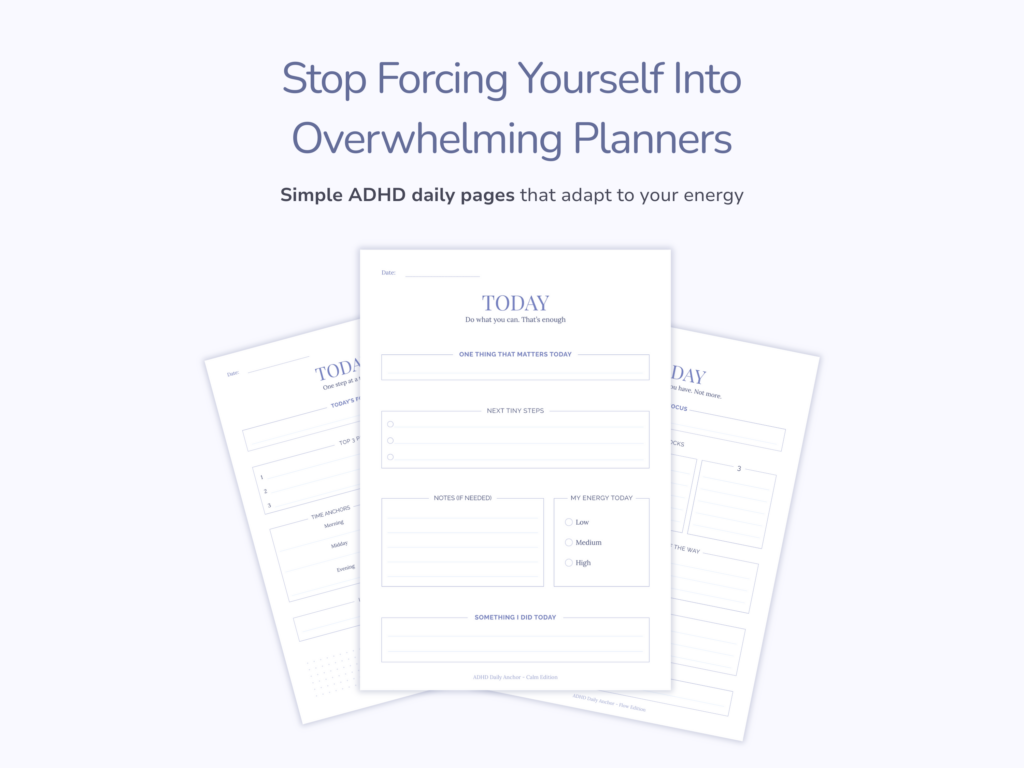
The ADHD Daily Anchor is designed to support ADHD daily focus without turning the day into a rigid plan. It helps you choose one main focus, set a few priorities, break tasks into tiny steps, and plan supportive moments — including dopamine breaks and what to do if overwhelm shows up.
There’s also space to unload mental noise and check in with your energy, so your day works with you instead of against you. This page isn’t about control or productivity — it’s about giving your attention a place to return to.
If you want a calm way to stay grounded and focused throughout the day, this tool can quietly support your rhythm.
A gentle reminder
Motivation alone isn’t enough for ADHD minds. They need orientation.
A clear anchor doesn’t limit you — it frees your attention. And even a simple one can change how the day unfolds.