

Why ADHD Organization Fails When Everything Is Treated the Same Way
25 February 2026
There’s a particular kind of exhaustion that comes from trying really hard to be organized — and still feeling like you’re failing. You buy the planner. You set up the system. You promise yourself that this time, you’ll finally stay on track.
And for a few days, it almost works. Then something slips. A missed day. Too many tasks. A tired morning. And suddenly the whole system feels heavy, accusing, impossible to return to.
Not because you didn’t try. Because everything inside it was treated as equally important. And for an ADHD mind, that changes everything.
Why ADHD Organization Feels So Hard
Most organization systems assume one thing: that all tasks can be handled in the same mental way. Same structure. Same energy. Same urgency. But ADHD doesn’t experience tasks equally.
Some things feel loud in your mind. Others disappear completely. Small tasks can feel overwhelming, while complex ones suddenly become hyperfocus zones. And when everything lives in the same list, your brain doesn’t see priorities — it sees pressure.
Something I noticed over time is that overwhelm rarely came from having too much to do. It came from not knowing where to start without choosing wrong.
When every task feels urgent, decision-making becomes exhausting. Your brain keeps looping: “This matters. But this too. And this. And this”. Until starting anything feels impossible.
This isn’t laziness. It’s cognitive overload.

Why Traditional Organization Systems Often Fail for ADHD minds
Many organization systems look perfect from the outside. Structured schedules. Detailed trackers. Carefully planned routines. At first, they feel reassuring. Like clarity has finally arrived. But what looks organized on paper can create invisible pressure in real life.
Most traditional systems assume consistency comes first — that relief appears once you follow the plan long enough. And when a day is missed, the system quietly changes meaning. Instead of support, it becomes a reminder of what didn’t happen.
The difficulty isn’t always obvious at first. It builds slowly. Because everything is treated the same way. Important tasks, small errands, creative ideas, low-energy days, urgent responsibilities — all placed inside one structure, asking for the same level of attention and effort.
For an ADHD mind, that creates constant internal competition. Nothing feels clearly prioritised. Everything feels equally loud. And when everything feels urgent, starting becomes harder than doing.
Something I came to understand over time is that the issue was never my ability to organize my life. The issue was trying to manage different kinds of tasks with one single mental approach.
Traditional systems are built for stability. ADHD operates through fluctuation. This isn’t a discipline problem. It’s a mismatch between the system and the brain using it.
The Shift: Organization That Respects Mental Energy
Things became simpler when I stopped asking one system to hold everything equally. Instead of managing all tasks at once, I began approaching organization one layer at a time. One task. One decision. One visible ending.
Not because doing less is the goal — but because clarity reduces mental noise.
For many ADHD minds, prioritizing isn’t difficult because priorities are unclear logically. It’s difficult because emotionally, everything feels equally loud.
A gentler approach separates tasks by state, not importance:
- What can I do with the energy I have right now?
- What needs focus?
- What simply needs to leave my head?
When organization adapts to energy instead of fighting it, something changes quietly. You start again more easily. And restarting matters more than consistency ever did. You’re allowed to pause without losing progress. Even if your brain tells you otherwise.

How to Approach ADHD Organization More Gently
A supportive system doesn’t try to control your behavior. It reduces friction. That often means:
- fewer decisions at once
- clear stopping points
- visible completion
- permission to return without catching up
Because the real challenge isn’t planning perfectly. It’s being able to come back after life interrupts you — without the system becoming harder to use.
Something many people don’t realize is that ADHD organization works best when abandonment is built into the design. Not failure. Flexibility.
A system that survives being dropped is a system you can trust. And trust is what makes organization sustainable.
If You Want Support Applying This
After struggling with rigid planners for years, I stopped trying to create something perfect and focused instead on something usable — especially on difficult days.
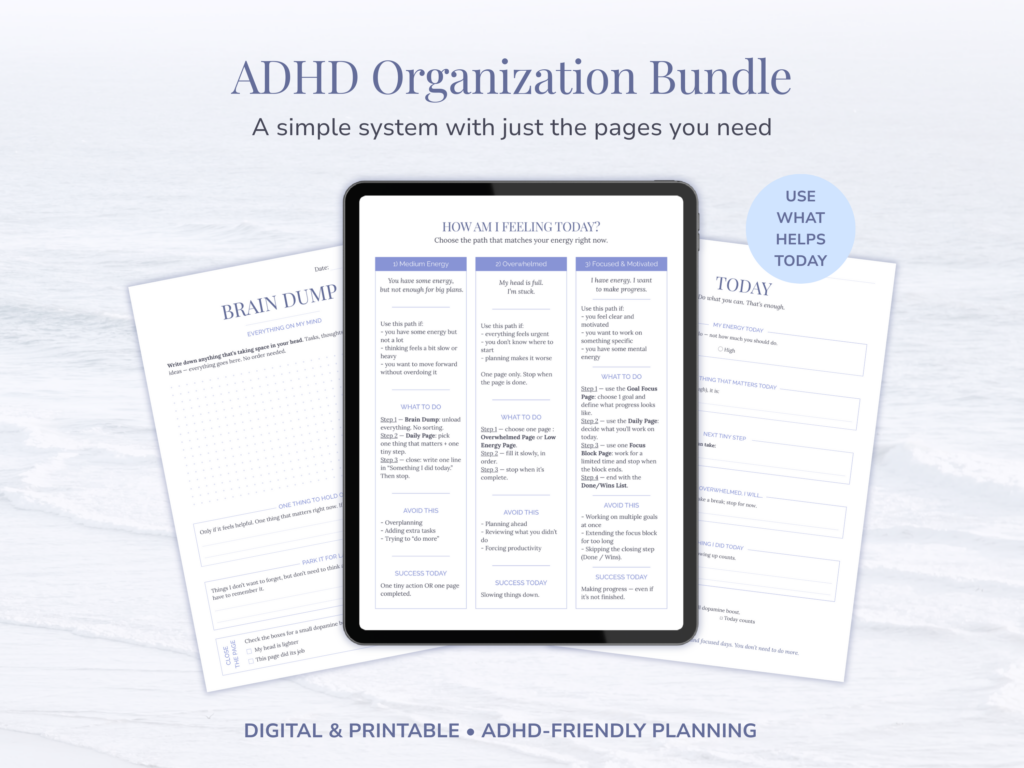
The ADHD Organization Bundle grew from that need. It isn’t a traditional planner or a fixed routine. It’s a collection of gentle planning pages designed for different mental states: moments when your head feels full, days when energy is low, short focus windows, or times when you need to reset without starting over.
Each page has a clear purpose and a clear ending, so organization doesn’t become endless. You don’t follow it in order. You don’t need consistency. Using less is part of how it works. It’s simply a supportive structure — a place to practice organizing in a way that adapts to you instead of asking you to adapt to it.
If this approach resonates, you can explore it quietly, at your own pace.
A Softer Way Forward
ADHD organization doesn’t fail because you lack discipline. It fails when systems assume your mind should behave like everyone else’s.
You don’t need a perfect system. You need one you can return to. Something simple enough to restart. Flexible enough to follow your energy. Gentle enough to remove guilt from the process.
Organization, at its best, isn’t about control. It’s about creating enough calm space to begin again — as many times as you need.