

Why ADHD Weeks Feel Chaotic — And Why Planning More Doesn’t Fix It
2 March 2026
If you have ADHD, you may know this moment very well. You look at your to-do list… and suddenly realize that almost nothing has been done.
You feel behind everywhere — work, home, personal life, messages unanswered, ideas unfinished. The week feels messy, heavy, already lost.
And the first instinct is almost always the same: “I need a better plan.” So you create new lists. You reorganize your planner. You promise yourself you’ll be more productive next week.
But somehow, the chaos comes back. Not because you failed — but because planning more is often not the solution ADHD brains actually need.
The Hidden Pattern Behind Chaotic ADHD Weeks
For a long time, I believed my problem was productivity. I thought I needed to:
- work faster,
- remove distractions,
- optimize my time,
- do more in less hours.
So every time I felt overwhelmed, I added structure. More systems. More rules. More expectations.
And each time, the pressure increased. Because the real problem wasn’t a lack of planning. It was the weight of unrealistic expectations.
When Planning Becomes More Pressure
Many traditional planning methods assume one thing: “If you organize enough, everything will fit”.
But ADHD weeks rarely work like that. Energy changes. Focus fluctuates. Emotions take space. Mental noise accumulates quietly.
So when your plan is built on an ideal version of yourself — focused, consistent, perfectly productive — reality quickly feels like failure.
You end the week disappointed, thinking: “I’m too slow”; “I can’t stay consistent”; “Why can everyone else manage except me?”
I reached a turning point when I realized something important: I wasn’t asking too little of myself. I was asking far too much. And no planner can fix expectations that are impossible to sustain.

ADHD Overwhelm Is Often Mental Overload, Not Poor Organization
What makes ADHD weeks feel chaotic is rarely laziness or lack of discipline. It’s accumulation. Unfinished tasks stay mentally open. Ideas compete for attention. Small responsibilities pile up silently.
Your brain keeps carrying everything at once. So adding new plans doesn’t reduce overwhelm — it adds another layer to manage.
What actually helps is something much simpler: emptying the mental load before organizing it.
Why a Weekly Reset Works Better Than Planning More
A weekly reset is not about controlling your week. It’s about clearing space first.
Instead of starting with scheduling, you begin with a brain dump — putting everything out of your head without judgment or prioritization.
Something shifts immediately. You see things more clearly. Some tasks suddenly feel less urgent. Others no longer matter at all. The pressure softens.
You are no longer reacting to invisible stress — you’re looking at reality with calmer eyes. After the brain dump, decisions become lighter because your brain is no longer holding everything at once.
What Makes an ADHD Weekly Reset Different From a Planner
A classic weekly planner asks: “What will you accomplish?” A weekly reset asks: “What actually matters right now?”
The goal is not productivity performance. It is relief. A good reset helps you:
- release mental noise
- let go of non-urgent tasks
- see priorities clearly
- reduce the feeling of being constantly behind.
Instead of pushing harder, you step back first. And paradoxically, that’s often when momentum returns.

A Gentle Tool for Starting Again Each Week
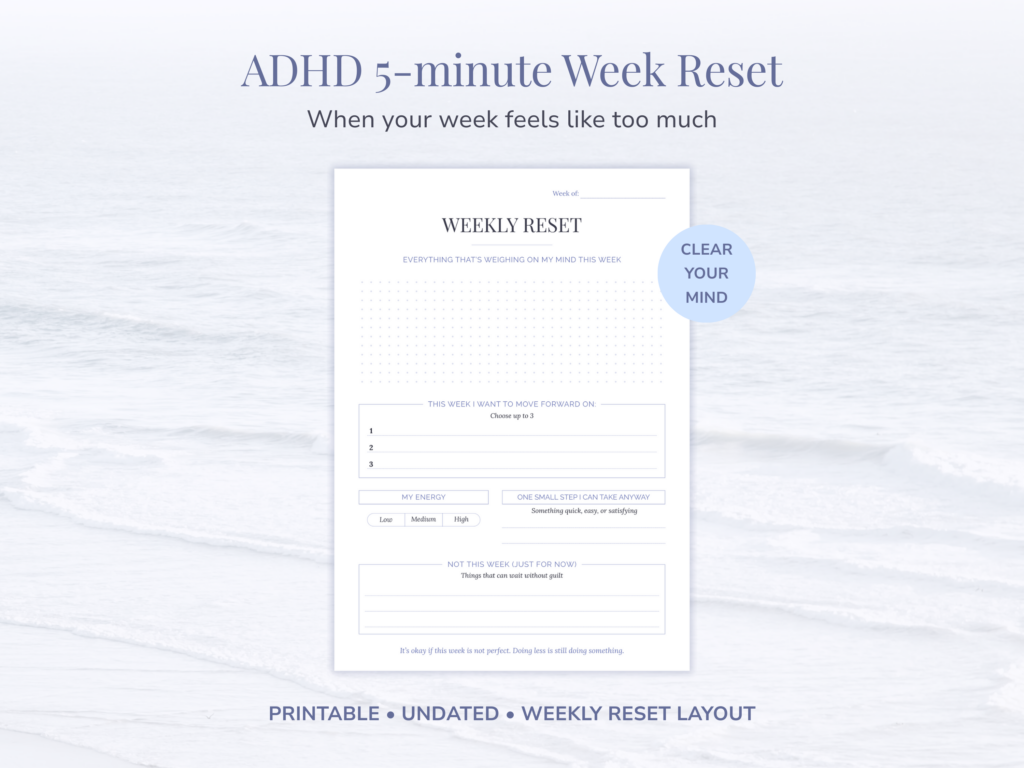
This is exactly why I created the ADHD Weekly Reset. Not as another planner to maintain perfectly, but as a soft weekly checkpoint.
A space to:
- unload everything on your mind
- reconnect with what is realistic
- choose fewer priorities
- and start the week feeling lighter.
Many people expect organization to come from doing more. But sometimes clarity comes from allowing yourself to do less — intentionally.
You Don’t Need a Better System. You Need Less Pressure.
If your weeks keep feeling chaotic, it doesn’t mean you lack discipline or motivation. It may simply mean your brain needs a pause before a plan. A reset instead of another promise to “try harder.”
Because ADHD support is not about forcing consistency. It’s about creating rhythms that respect how your mind actually works — and giving yourself permission to begin again, gently, every week.