

Why Grief Often Has No Words — And Why That’s Normal
25 February 2026
Sometimes the hardest part of grief isn’t the pain. It’s the silence. You try to explain what you feel, and nothing comes out clearly. Words feel too small, too precise, or simply unavailable. People ask how you are, and the question itself feels impossible to answer.
Not because nothing is happening inside. Because too much is. And for many people, this is one of the most confusing parts of loss — the feeling that you should be able to describe what you’re going through, but can’t.
There is no clear sentence for grief. And that is not a problem to solve.
Why Grief Often Lives Beyond Words
We often imagine emotions as things we can name. Sadness. Anger. Acceptance.
But grief rarely moves in clean emotional categories. It shifts quietly, sometimes hourly. One moment feels heavy, another strangely empty. Some days feel normal until a small detail changes everything. A memory. A place. A silence where something used to exist.
Much of grief happens internally, in ways that don’t translate easily into language. It unfolds in private spaces — thoughts you don’t share, moments when you withdraw without fully understanding why, evenings that feel heavier once you are alone.
This doesn’t mean you are avoiding your grief. It means your mind is processing something too complex for immediate expression. Grief is not only emotional. It is experiential. And experiences take time before they become words.
Why Not Having Words Can Feel So Unsettling
Modern culture quietly teaches us that healing involves expression. Talking about feelings. Explaining what hurts. Sharing openly. So when words don’t come, many people assume they are doing grief “wrong.” But grief is not a performance.
Some losses reshape your inner world in ways that others cannot fully see or understand — even people who care deeply. Questions like “How are you holding up?” can feel difficult not because they are unkind, but because the answer does not exist yet.
You may not know how you are. You may not want to explain. And sometimes, grief needs protection more than explanation. Silence is not emotional failure. It is often emotional safety.

The Quiet Work Happening Inside You
Something many people don’t realize is that a large part of grieving happens beyond conscious understanding. Your mind revisits memories. Your identity adjusts slowly. Your sense of reality reorganizes itself. This work happens whether or not you speak about it.
When words are absent, other forms of expression often appear first: images, sensations, fragments of thoughts, or the simple need to be alone for a while.
This doesn’t mean you are stuck. It means grief is moving at its own pace. Not everything meaningful can be explained immediately. Some emotions need to exist before they can be described. You are allowed not to know what you feel yet.
A Gentler Way to Express What Has No Name
Expression doesn’t always begin with conversation. For many people, it begins privately — through writing, drawing, or simply placing thoughts somewhere outside the mind without needing coherence.
Writing during grief isn’t about finding the right words. It’s about allowing imperfect ones. Half sentences. Contradictions. Silence between lines.
Sometimes writing doesn’t clarify emotions. It simply makes space for them to exist without pressure. And that can be enough. Because grief rarely asks for solutions. It asks for room.
This is not about moving on. It is about learning how to carry what remains.

If You Want Support When Words Feel Difficult
During my own periods of emotional rebuilding, I noticed that starting from a blank page often felt too overwhelming. I didn’t need instructions or goals — only a gentle place to begin.
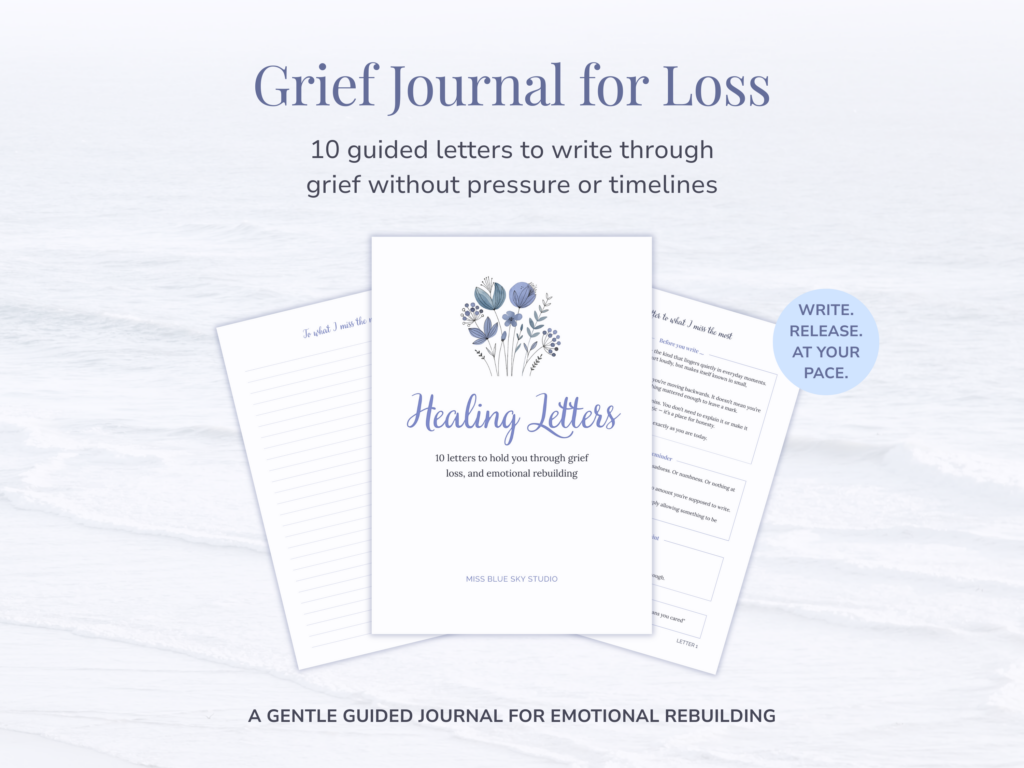
That’s why I created Healing Letters, a quiet writing kit made of ten guided letters designed for moments when grief feels present but hard to express.
Each letter offers a soft introduction and simple prompts, not to analyze or fix anything, but to help you sit with what you’re carrying at your own pace. You can follow them in order or open one only when it feels right.
There is no timeline. Nothing to complete. No expectation to feel better. Just a supportive space for honesty, even when words come slowly — or barely at all. If this feels helpful, you can explore it gently, whenever you feel ready.
When Silence Is Part of Healing
Grief does not always speak loudly. Sometimes it withdraws. Sometimes it waits. Sometimes it lives quietly inside you for longer than expected.
This doesn’t mean you are stuck or doing something wrong. It means something important is being processed in a language deeper than words.
You don’t need to explain your grief perfectly. You don’t need to share more than you want to. For now, it is enough to let your experience exist — exactly as it is — until language finds you again, naturally and in its own time.