
Why Traditional Gratitude Practices Increase Stress — And What Works Instead
8 April 2026
Trying to feel grateful when your mind is already full can feel… wrong.
You know you should appreciate what you have. You know things could be worse. You even remind yourself of that sometimes.
And yet, instead of feeling better, something tightens inside you. Because forcing gratitude doesn’t create calm. It creates pressure. Let’s talk about why.
When Gratitude Becomes Another Thing You “Should” Do
Gratitude is supposed to feel light. But somewhere along the way, it became another rule. Write three things every day. Stay positive. Shift your mindset.
And if you can’t? You start feeling like you’re doing something wrong. Especially when life feels heavy. Even when you know you’ve been through worse. Even when you know you should be able to “handle this.”
But daily stress, mental load, and constant worries don’t disappear just because you try to override them with positivity. And that’s where the disconnect happens.
The Hidden Pressure Behind “Positive Thinking”
There’s something no one talks about enough: gratitude becomes stressful when it asks you to ignore how you actually feel.
When you’re overwhelmed, tired, or emotionally drained… Being told to “focus on the positive” can feel like:
- minimizing your experience
- dismissing your emotions
- forcing a version of yourself that isn’t real in that moment
And your brain resists it. Not because you’re negative. But because you’re honest.

Why Most Gratitude Practices Don’t Work for Overwhelmed Minds
Most gratitude practices are built like rigid routines. Structured. Repetitive. Sometimes overwhelming. And when your energy is low, when your thoughts feel messy, when your day already feels like too much…
You don’t need another system to follow. You need something that meets you where you are.
But not all gratitude practices are like this. Some are designed differently — not to force positivity, but to gently guide your attention back to what still feels supportive, even on hard days. And that changes everything.
What Actually Works Instead (And Feels Good)
Gratitude becomes helpful again when it’s:
- simple
- flexible
- low-effort
- emotionally honest
Not long lists. Not forced positivity. Not “perfect” journaling. Just small moments of noticing. A quiet minute. A tiny win. Something that didn’t make your day worse.
That’s enough. Sometimes, gratitude looks like:
- “I got through today.”
- “I had one calm moment.”
- “I didn’t give up.”
And that counts. More than you think.

The Shift That Changes Everything
You don’t need to be more positive. You need to make gratitude easier to access.
When it stops being a performance… It becomes a support. Something you can return to — even on the days when everything feels heavy. Especially on those days.
A Gentle Way to Practice Gratitude (Without Pressure)
This is exactly what I couldn’t find in traditional gratitude practices. Something simple. Something flexible. Something that doesn’t ask you to feel good first.
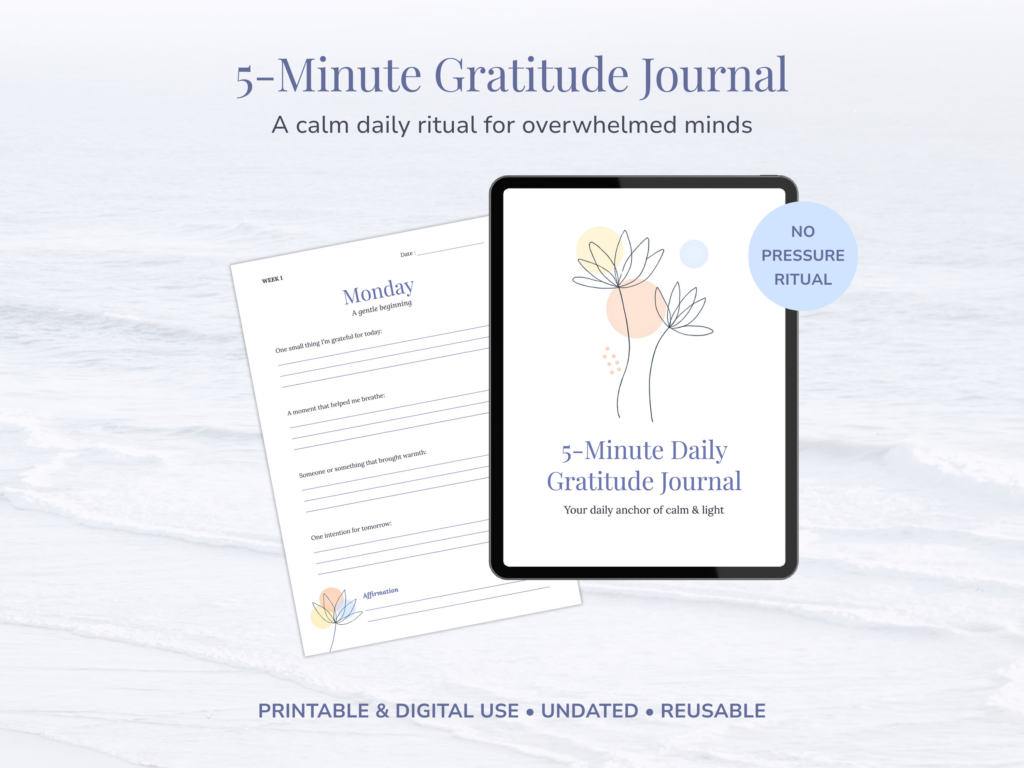
That’s why I created the 5-Minute Daily Gratitude Journal. It’s not about writing pages or forcing positivity. It’s about taking a few quiet minutes to notice what’s already there — even if it’s small.
Each page is designed to feel light and accessible, with soft prompts like:
- one small thing you’re grateful for
- a moment that helped you breathe
- something that brought a bit of warmth
You can write one word. One sentence. Or nothing more. Because some days, that’s enough. And that’s how consistency actually happens.
If Gratitude Has Felt Hard, Read This
You’re not bad at gratitude. You’ve just been given a version of it that doesn’t fit your reality.
You don’t need to force yourself to see the big picture. Start with the smallest things. The quiet ones. The almost invisible ones. That’s where it begins.