
15 Small Things to Do After a Stressful Day When Your Brain Won’t Slow Down
29 May 2026
Some days stay with you longer than you want them to. You come home, the hard part is technically over, but your mind is still running. You replay conversations. You remember everything you forgot. You think about tomorrow. You feel tired, but not calm. Your body wants rest, but your brain is still trying to solve everything at once.
If this is where you are tonight, you don’t need to fix your whole life. You don’t need a perfect evening routine. You don’t need to become calm instantly. You don’t need to process every feeling before you’re allowed to rest.
You just need one small thing that helps your nervous system slow down. Here are 15 gentle things to try after a stressful day when your brain won’t stop spinning.
1) Change the lighting around you
Bright lights can make a stressful day feel even louder. Try turning off the overhead lights and switching on a softer lamp, fairy lights, or a small warm light. This is a simple signal to your body that the day is shifting into a slower mode.
You are not trying to create a perfect calming atmosphere. You are just making your space feel a little less intense.
2) Put one hand on your chest and one on your stomach
This is a tiny grounding exercise for moments when you feel scattered or overstimulated.
Place one hand on your chest and one hand on your stomach. Take a slow breath and simply notice the contact. You don’t need to force deep breathing if that feels uncomfortable. Just feel your hands there.
It can help bring your attention back from your racing thoughts into your body.
3) Write a “not solving this tonight” list
After a stressful day, your brain may try to solve every problem before bedtime. Instead, write down anything you are not going to solve tonight. For example:
- “I am not solving the work problem tonight.”
- “I am not deciding everything about tomorrow tonight.”
- “I am not replaying that conversation tonight.”
This is not avoidance. It is a boundary. Some thoughts can wait until your brain has more energy.
4) Do a 5-minute messy brain dump
If your mind feels too full, give your thoughts somewhere to land.
Set a timer for five minutes and write whatever is in your head without organizing it. Tasks, worries, random thoughts, frustrations, reminders — let it all come out.
You don’t need beautiful journaling. You don’t need complete sentences. The goal is not to make sense of everything immediately. The goal is to stop carrying it all inside your head.

5) Make a “tomorrow can start with this” note
Sometimes stress gets worse because tomorrow already feels overwhelming. Choose one tiny thing that would make tomorrow easier and write it down.
Not a full plan. Not a long to-do list. Just one starting point. It could be:
- “Open the document.”
- “Put laundry in the basket.”
- “Reply to one message.”
- “Drink water before checking my phone.”
A small starting point can help your brain stop trying to plan the entire day at night.
6) Create a small transition ritual
Your brain may need help understanding that the stressful part of the day is over. Choose one small action that marks the transition.
You could wash your face, change into softer clothes, put your hair up, make tea, light a candle, or play the same calming song every evening.
It doesn’t have to be deep or aesthetic. It just tells your body “We are not in the same mode anymore.”
7) Step outside for two minutes
You don’t need a long walk to feel a small shift. Stand outside for two minutes. Feel the air on your skin. Look at the sky. Notice one sound. Let your eyes focus on something that is not a screen, a task, or a problem.
After a stressful day, your world can feel very small and very mental. A few minutes outside can remind your body that there is still space around you.
8) Do a “body unload”
Stress often stays in the body even when the day is over. Try this: tense your shoulders for a few seconds, then release. Squeeze your hands into fists, then open them. Press your feet into the floor, then soften.
You are not trying to do a full workout or a perfect relaxation exercise. You are simply giving your body a way to let go of some of the tension it has been holding.
9) Choose one comforting sensory thing
When your brain is loud, sensory comfort can be more helpful than trying to think your way into calm.
Choose one simple sensory thing:
- A soft blanket.
- A warm drink.
- A calming scent.
- A cozy sweater.
- A warm shower.
- A heating pad.
- A piece of chocolate eaten slowly.
Let it be small. Let it be real. Let it bring you back to the present moment.
10) Make a “facts vs feelings” check
After a stressful day, feelings can start presenting themselves as facts. You might think:
- “I’m failing.”
- “Everything is too much.”
- “I can’t handle this.”
- “Tomorrow will be awful.”
Try writing two columns: Facts and Feelings. A feeling might be: “I feel behind.” A fact might be: “I have three things to deal with tomorrow.”
This does not erase the feeling. But it can help your brain see the situation more clearly and gently.

11) Give your mind a soft focus activity
Sometimes doing “nothing” makes your brain louder. A soft focus activity gives your mind something gentle to land on without demanding too much energy.
Try folding laundry slowly, coloring, doing a puzzle, watering plants, tidying one small surface, or preparing something simple for tomorrow.
The key is to choose something low-pressure. Not something that turns into a whole productivity spiral. Just enough to help your brain stop spinning in circles.
12) Ask: “What is still mine to carry tonight?”
This question can be surprisingly calming. After a stressful day, you may be carrying other people’s moods, unfinished work, future worries, and problems that cannot be solved right now.
Ask yourself: “What is still mine to carry tonight?”
Maybe one thing is yours. Maybe nothing is yours until tomorrow. Maybe what you need to carry tonight is simply your tired body to bed. You are allowed to put some things down.
13) Lower the standard for the rest of the evening
A stressful day is not the moment to demand a perfect night from yourself.
Maybe dinner is simple. Maybe the house stays messy. Maybe your evening routine becomes brushing your teeth and getting into bed. Maybe you answer the message tomorrow.
Lowering the standard is not giving up. It is choosing care over pressure. Some evenings are not for catching up. They are for coming down.
14) Do one “closing the day” sentence
Before bed, write one sentence to close the day. Something like:
- “Today was heavy, but I made it through.”
- “I do not need to solve everything tonight.”
- “I am allowed to rest before everything is fixed.”
- “This day is done, and I can begin again tomorrow.”
A simple sentence can help your brain stop treating the day like an open tab. You are allowed to close it gently.
15) Choose rest before you feel fully ready
This one is hard. Many of us wait to feel calm before we rest. We wait until the thoughts are sorted, the tasks are handled, the emotions make sense, and the house feels peaceful.
But sometimes rest has to come first.
You can go to bed with unanswered questions. You can rest with a messy mind. You can sleep before you have everything figured out. You are not required to earn rest by becoming perfectly calm.
You Don’t Have to Fix Your Whole Life Tonight
A stressful day can make everything feel urgent. But you do not need to process your whole life, make a perfect plan, and become a calmer person before bedtime.
You just need one small way to help your mind and body slow down. One breath. One note. One boundary. One soft light. One small release.
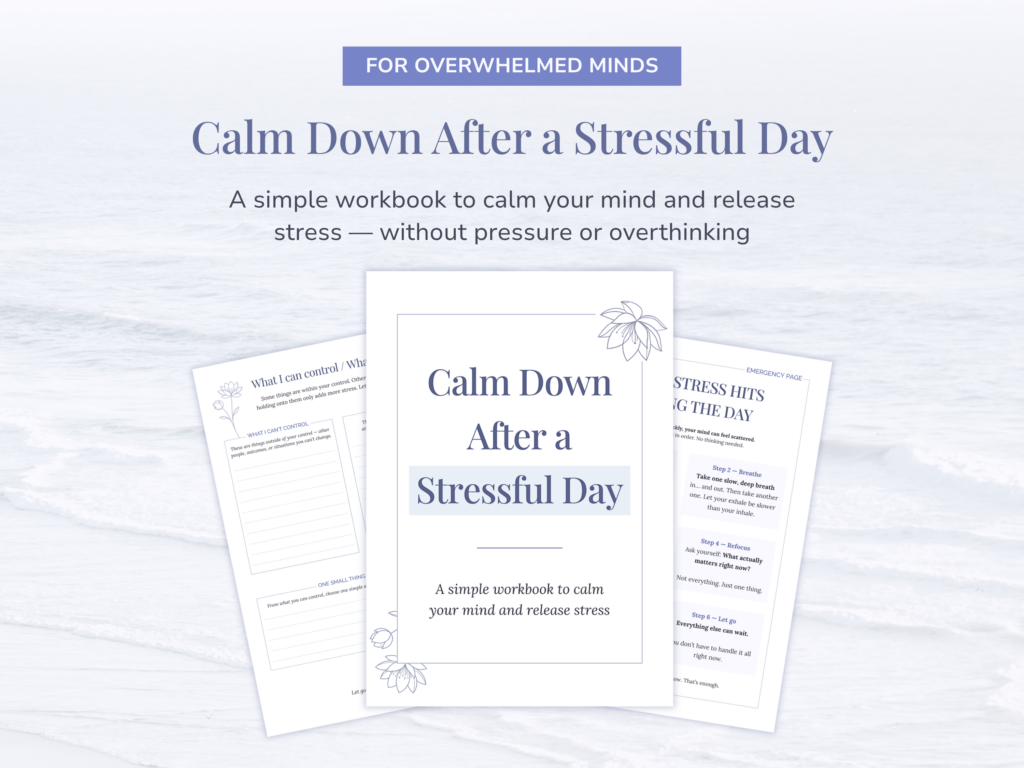
And if your mind feels too full to know where to start, the Stress Relief Workbook was created for exactly that kind of moment.
It gives you a simple, guided space to let everything out, separate facts from feelings, notice what you can and can’t control, release what feels heavy, and come back to one small next step. It also includes calming body-based exercises like breathing, grounding, and gentle tension release, so you are not trying to think your way out of stress alone.
You do not need to do everything. You just need a place to pause, reset, and breathe again.