

7 Signs Your Brain Is Overloaded (And What to Do First)
18 May 2026
There’s a specific kind of exhaustion that sleep doesn’t fix. Not physical tiredness. Not laziness. Not a lack of motivation. It’s the feeling that your brain has too many tabs open at the same time — and none of them will stop making noise.
You try to focus on one thing, but your mind immediately jumps to fifteen others. You start tasks without finishing them. You forget things while thinking about other things. You feel irritated, overwhelmed, emotionally “full,” and somehow unable to properly slow down.
For a long time, I thought this meant I lacked discipline. But in reality, it was usually a sign that my brain was overloaded long before I realized it.
And the problem is: when your brain reaches that point, productivity advice often makes things worse.
Because what you need first is not a better system. You need mental relief.
1) You Feel Irritated by Everything
One of the first signs of mental overload is irritability. Small things suddenly feel enormous. Noise feels unbearable. Interruptions feel aggressive. Simple questions feel exhausting.
Not because you’re a bad person. But because your brain is already saturated.
When your mental load is too high, your nervous system has very little space left to process additional stimulation calmly.
2) Your Thoughts Keep Looping in Circles
You think about the same things repeatedly without reaching clarity. You replay tasks. Conversations. Things you need to remember. Things you “should” already have done.
Your brain keeps trying to hold everything at once — and ends up creating mental noise instead of solutions. This is often the moment where people start feeling like they’re “losing control,” when in reality their brain simply has nowhere safe to put information anymore.

3) You Start Everything and Finish Nothing
This is one of the most misunderstood signs of overwhelm. People often interpret unfinished projects as laziness, inconsistency, or lack of determination. But sometimes, it’s the exact opposite.
Sometimes your brain is carrying so much mental clutter that it no longer has enough bandwidth to sustain focus until the end of a task.
You’re not failing because you don’t care. You’re struggling because everything feels equally urgent at the same time.
4) You Can’t Focus Without Thinking About 10 Other Things
You sit down to work on one task… and suddenly remember:
- an email you forgot to answer,
- something you need to buy,
- a message you should send,
- a random idea,
- a future problem,
- something you forgot three weeks ago.
Your brain keeps pulling you away from the thing in front of you. Not because you’re incapable of concentrating — but because your mind is desperately trying not to lose information.
5) You Feel Like You’re Drowning in Invisible Pressure
This is the “I can’t breathe mentally” feeling. Nothing looks catastrophic from the outside. But internally, everything feels heavy at once.
You don’t even know where to begin anymore because your brain stopped distinguishing between:
- important things,
- small things,
- urgent things,
- emotional things,
- random things.
Everything merges together into one giant mental pile.
6) You Become Reactive Instead of Intentional
When your brain is overloaded, you stop making calm decisions. You start reacting to whatever screams the loudest in the moment.
You jump from one task to another. You answer messages while doing something else. You multitask constantly. You move without thinking.
It feels productive at first. But most of the time, it only creates more mental chaos and exhaustion.

7) Rest Doesn’t Actually Feel Restful
You finally sit down to relax… but your brain keeps running in the background. You’re technically resting, but mentally still “on.”
Because unresolved mental clutter follows you everywhere. And until your brain feels safe enough to release that overload, true rest becomes difficult.
So What Should You Do First?
Not organize your entire life. Not build the perfect routine. Not force yourself into another complicated productivity system.
First, you need to get things out of your head. Because your brain is not designed to permanently store every task, reminder, emotion, responsibility, and unfinished thought all at once.
One thing that changed a lot for me was stopping the endless “mental holding.” Now, when I notice that drowning feeling starting to appear, I pause and put everything onto paper — messy, incomplete, unfiltered.
Not to create the perfect plan immediately. Just to give my brain somewhere else to place the weight. That alone often reduces the mental pressure more than trying harder ever did.
A Simple Way to Start Untangling Mental Overload
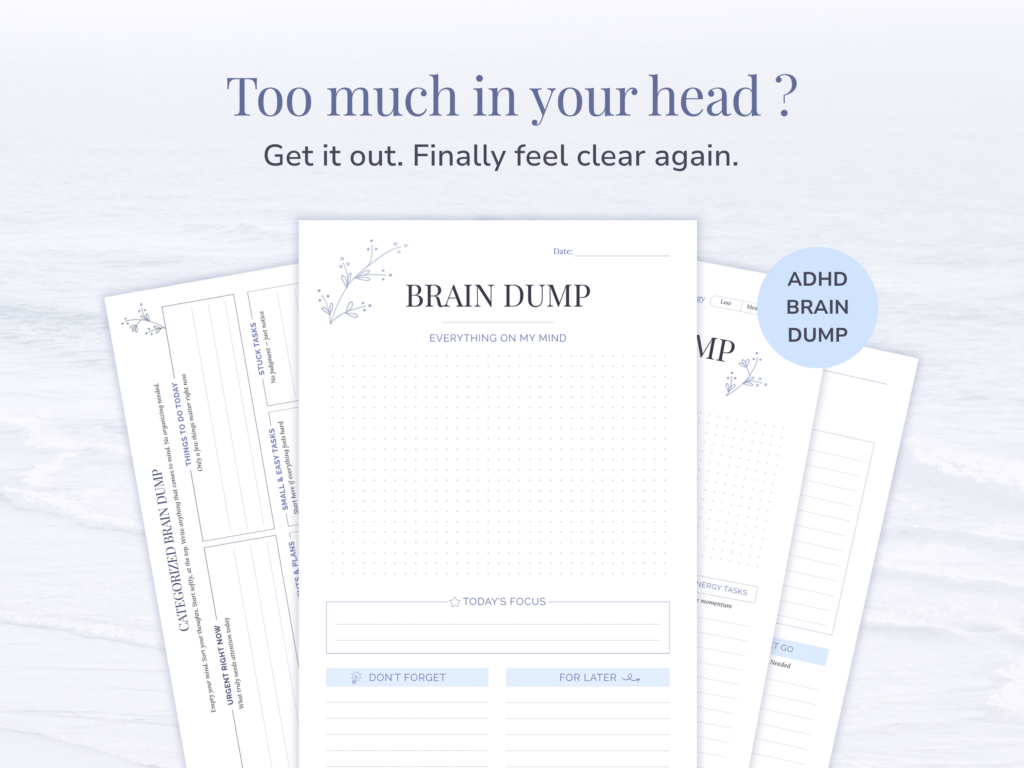
Instead of trying to instantly “get your life together,” it can help to first separate the noise from what actually matters. That’s why I created the ADHD Brain Dump.
Not as another rigid planner or productivity method. But as a place to unload everything your brain keeps trying to carry at once. The pages help you:
- empty your thoughts without pressure,
- sort what needs attention now,
- identify what can wait,
- notice what can be let go,
- and reconnect with your actual energy level before making decisions.
Because sometimes the first real step forward is not “doing more.” It’s finally giving your brain room to breathe again.
If your brain feels overloaded lately, you probably do not need more guilt, more pressure, or more discipline.
You may simply need less mental weight. And that starts by stopping the impossible task of trying to hold everything inside your head all at once.