
I Created a Weekly Reset Routine Because My Weeks Kept Falling Apart
28 May 2026
Some weeks don’t fall apart dramatically. They fall apart quietly. One missed task. One unexpected appointment. One day where your energy disappears for no clear reason. One message you forget to answer. One thing you keep pushing to tomorrow until suddenly the whole week feels messy, heavy, and impossible to restart.
For a long time, this is what my weeks felt like. I would start with good intentions. I would try to plan properly. I would tell myself, “This week, I’m going to stay on top of things.” And then life would happen.
Something would take longer than expected. I would get overwhelmed. My brain would start holding too many open loops at once. I would lose track of what actually mattered. Then, instead of gently adjusting, I would do what so many overwhelmed minds do:
I would decide the week was ruined. And once the week felt ruined, I would wait for the next Monday to “start again properly.” Spoiler: that perfect Monday reset usually lasted about two days.
That is why I created a weekly reset routine — not because I became amazingly organized, but because I finally accepted that my organization was never going to be perfectly linear.
I needed a way to come back when things got messy. Not next week. Not after I had caught up on everything. Not when I magically became a different person. Right there, in the middle of the chaos.
Why Traditional Weekly Planning Didn’t Work for Me
Most weekly planning advice sounds simple on paper:
- Plan your week.
- Choose your goals.
- Break everything into tasks.
- Stay consistent.
- Review your progress.
And honestly? That can work beautifully when your brain feels clear, your energy is steady, and nothing unexpected happens.
But when you have an ADHD brain, an overwhelmed mind, or a life that doesn’t move in neat little boxes, traditional planning can quickly become another place to fail.
Because the problem is not always that you don’t know how to plan. Sometimes the problem is that your brain is already overloaded before you even begin.
You sit down to organize your week, and suddenly everything feels urgent. Every task feels important. Every little thing you forgot comes rushing back at the same time. So instead of feeling clearer, you feel worse.
That was the shift that changed everything for me. I didn’t need a more complicated weekly planner. I needed a reset. A pause. A way to empty my head, look at the week honestly, and decide what deserved my energy without trying to fix my entire life in one sitting.
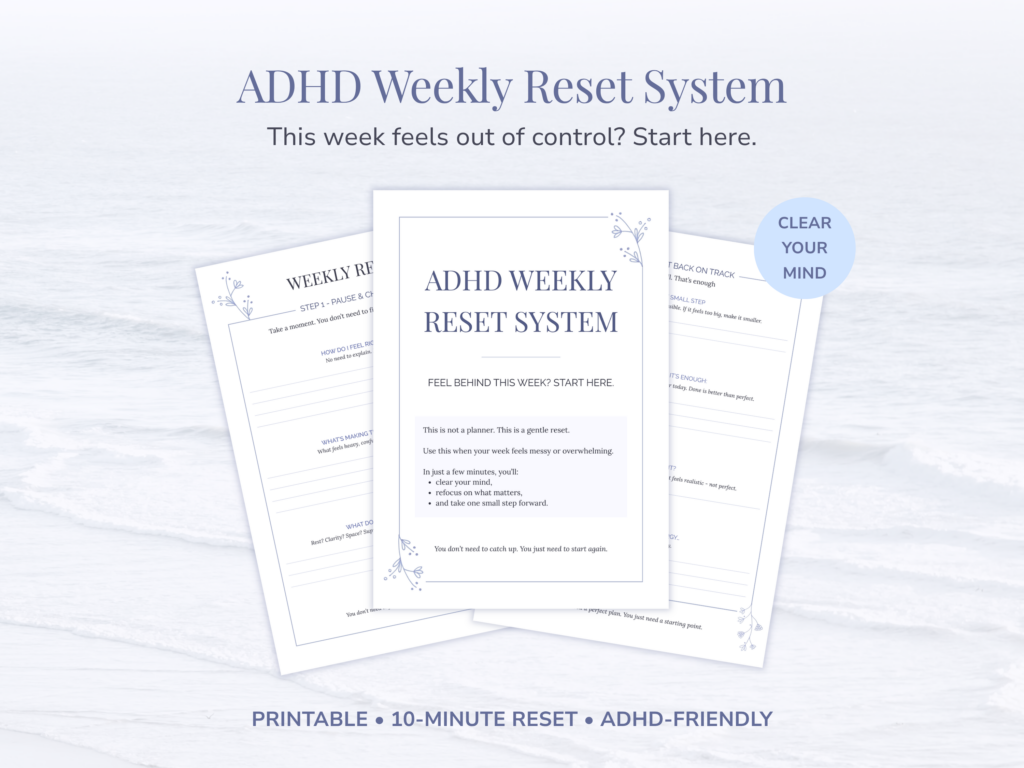
That is the exact idea behind the ADHD Weekly Reset: it is not a productivity review, and it is not a strict weekly planner. It is a gentle reset page for the moments when your week feels messy, heavy, or already off track.

Your Week Is Allowed to Need a Reset
This is the part I wish someone had told me earlier: Needing a reset does not mean you failed. It means your system needs space for real life.
For so long, I thought good organization meant creating a plan and following it perfectly. If I fell behind, forgot something, or lost momentum, I assumed I was the problem.
I told myself I was inconsistent. I told myself I was lazy. I told myself I was just bad at staying organized.
But what if the issue was not me? What if the issue was that I was trying to use systems that assumed my energy, focus, and life would stay predictable? That is not how real weeks work. Especially if your brain is easily overwhelmed, if your attention gets pulled in ten directions, or if one unexpected thing can throw off your entire rhythm.
A realistic organization system should not only help you plan. It should help you return.
That is why the ADHD Weekly Reset starts with a different energy. It does not ask, “What did you achieve?” or “Why are you behind?” It starts with a pause and a check-in.
How do I feel right now? What is making this week feel hard? What do I need most right now? Because sometimes the most productive thing you can do is stop pretending you are fine and actually notice what is happening.
Step 1: Pause Before You Try to Fix Everything
When my week starts falling apart, my first instinct is usually to panic-plan. I want to fix everything immediately. Rewrite the whole week. Catch up on every delayed task. Become a brand-new version of myself by 4 p.m.
Very calm. Very realistic. Very sustainable. Except not at all.
The first step of my weekly reset routine is now much softer: pause first. Not fix. Not optimize. Not make a giant plan. Just pause.
This matters because when you are overwhelmed, your brain often treats every task like an emergency. You need a moment to separate the feeling of chaos from the actual situation.
That is why the first page of the ADHD Weekly Reset is a simple check-in. It gives you space to notice how you feel, what feels heavy, and what you might need before you start making decisions.
It is a small shift, but it changes the whole tone of the reset. You are not sitting down to punish yourself for falling behind. You are sitting down to understand what is going on. And that is a much kinder place to begin.
Step 2: Clear the Mental Load
Once I pause, I usually realize something important: the week feels impossible because I am trying to hold everything in my head:
- Tasks
- Appointments.
- Tiny admin things.
- Messages to answer.
- Things I forgot.
- Things I might forget.
- Things I should have done.
- Things I am worried about.
- Things that are not even urgent but keep taking up space anyway.
No wonder the week feels heavy. A huge part of my weekly reset routine is simply getting the mental load out of my brain and onto paper. Not in a perfect order. Not beautifully categorized. Not as a polished to-do list. Just out.
This is why the ADHD Weekly Reset includes a “clear the mental load” section with separate spaces for tasks on your mind, things you keep thinking about, and things you are worried about.
Because mental clutter is not always just tasks. Sometimes what drains you is the invisible layer around the tasks: the worry, the guilt, the “I need to remember this,” the “I hope I don’t forget that,” the background noise that makes everything feel bigger than it is.
Writing it down does not solve everything. But it does something powerful: it gives your brain less to carry alone. And when your brain is carrying less, it becomes easier to see what actually needs your attention.
Step 3: Choose What Actually Matters This Week
This is where my old weekly planning habits used to go wrong. I would look at everything in my head and decide that all of it mattered. Every task. Every idea. Every delayed thing. Every “I should probably…” And because everything mattered, nothing felt manageable.
Now, my weekly reset routine includes a very strict but gentle question: What truly matters this week? Not what could be done. Not what would be ideal. Not what a perfect version of me would complete. What actually matters?
The ADHD Weekly Reset keeps this beautifully simple by asking you to choose up to three priorities. Only three. That limit is important. Because overwhelmed minds do not usually need more options. They need fewer decisions. They need a smaller field of focus. They need permission to stop treating every task like it has the same emotional weight.
This is also where the reset asks what feels urgent but might not be. And honestly, that question can be a little confronting in the best way. Because sometimes the thing screaming the loudest in your brain is not the thing that matters most. Sometimes it is just the thing with the most guilt attached to it.
A weekly reset helps you gently separate urgency from importance. And that alone can make the week feel less impossible.

Step 4: Decide What You Are Not Doing This Week
This might be my favorite part of the routine. Because most planning systems only ask what you are going to do. But if your week is already heavy, you also need to decide what you are not doing.
Not because you are giving up. Not because you are lazy. Not because you are incapable. Because your energy is real. Your capacity is real.
And pretending everything can fit into the week does not make you more productive. It usually just makes you more ashamed when it doesn’t happen.
The ADHD Weekly Reset includes a full section for letting things go for now: what can wait, what feels important but not possible right now, and what you choose to release without guilt.
That last part matters. Without guilt. Because for many of us, postponing something does not feel neutral. It feels like failure. It feels like proof that we are behind again.
But sometimes, consciously setting something aside is not failure. It is focus. It is saying, “This matters, but not right now.” It is saying, “I cannot carry everything this week.” It is saying, “Doing less is still moving forward.”
That is the kind of organization I can actually trust. Not the kind that pretends I will suddenly become limitless. The kind that helps me make honest choices with the energy I actually have.
Step 5: Find One Small Way Back
After the pause, the brain dump, the priorities, and the letting go, I do not end my reset with a huge action plan. That would defeat the whole point. I end with one small next step. Something simple. Something doable. Something that does not require a perfect mood, a perfect day, or a perfect version of me.
The ADHD Weekly Reset guides you into this gently: choose your next small step, decide when you will do it, and name what would be enough if you only did that. This is such an important reframe.
Because when a week has gone off track, it is tempting to believe you need a big comeback. A full reset. A full catch-up day. A full life reorganization.
But most of the time, you do not need a dramatic comeback. You need a starting point:
- One email.
- One load of laundry.
- One appointment booked.
- One messy brain dump.
- One decision made.
- One tiny action that tells your brain, “We are not stuck anymore.”
That is enough. Not forever. But for today? Enough.
A Weekly Reset Is Not About Becoming Perfectly Organized
The biggest change this routine gave me was not a perfect week. It was a different relationship with messy weeks. I stopped seeing every disrupted plan as proof that I was bad at organization. I started seeing resets as part of the system.
Of course the week might go off track. Of course my energy might change. Of course I might need to pause and re-enter the week from the middle. That is not a personal failure. That is real life.
And if you have ADHD or an overwhelmed mind, building resets into your organization system can be so much more supportive than constantly trying to force yourself into a perfect routine.
Because the goal is not to never fall behind. The goal is to know how to come back without shame.
That is why I created the ADHD Weekly Reset. It gives you a simple place to land when your brain feels full and your week feels messy. It helps you clear your mind, choose what matters, release what can wait, and move forward with one small step instead of waiting for the next perfect Monday.
You Don’t Need to Wait Until Monday to Start Again
If your week is already falling apart, you do not need to throw the whole thing away. You do not need to wait until Monday. You do not need to catch up on everything first. You do not need to become perfectly consistent before you deserve a fresh start.
You can reset today. In the middle of the mess. In the middle of the week. In the middle of feeling behind. You can pause, empty your head, choose what matters, let something go, and take one small step back toward yourself.
That is still organization. That is still progress. And honestly, for overwhelmed minds, it might be the most realistic kind.
If your weeks often start with good intentions and end in guilt, the ADHD Weekly Reset was created for exactly that moment. Not to make you more perfect, but to help you gently start again when things feel too much.
Because you do not need a perfect plan. You just need a way back.