

ADHD Task Initiation: How to Start a Task When Your Brain Says “Not Now”
15 June 2026
ADHD task initiation can feel strangely impossible sometimes. You know what you need to do. Maybe it’s an important email, a work project, a household task, or a piece of admin you’ve been avoiding for days.
You know it matters. You know it probably won’t take forever. And yet your brain keeps saying: “Not now.”
So you do something else. You check your phone. You scroll for a few minutes. You answer a message. You tidy up a random corner of the house. You suddenly decide this is the perfect time to reorganize your tabs, your desk, or your entire personality.
An hour later, the task is still there. And now you’re carrying something extra: guilt. If this sounds familiar, you’re not lazy. You’re not broken. And you’re definitely not the only one.
In this article
What Is ADHD Task Initiation?
ADHD task initiation is the ability to begin a task, especially when it feels boring, unclear, overwhelming, stressful, or emotionally uncomfortable. And for many ADHD brains, starting can be the hardest part.
Not because you don’t care. Not because you don’t understand the task. Not because you’re secretly choosing chaos as a lifestyle brand. But because knowing what to do doesn’t always translate into being able to start doing it.
That gap between knowing and doing can feel incredibly frustrating. You may look at the task, understand exactly why it matters, and still feel frozen.
Sometimes the task feels too big. Sometimes it has too many steps. Sometimes it’s painfully boring. Sometimes it comes with fear of failure, pressure, or the horrible possibility of doing it “wrong.”
And sometimes, honestly, you don’t even know why you’re avoiding it. You just feel stuck.
Why ADHD Task Initiation Feels So Hard
For me, ADHD task initiation struggles often show up with administrative tasks.
- Paying invoices.
- Filing business paperwork.
- Filling out forms.
- Checking something important but boring.
- The kind of tasks that aren’t necessarily difficult, but somehow feel incredibly heavy when it’s time to begin.
Instead of starting, I’ll often reach for quick dopamine. I’ll scroll social media, watch videos, or suddenly work on something completely unrelated.
The funny thing is, I’m often still being productive. I’m just not doing the thing I was actually supposed to do. And when I look closer, the problem is rarely laziness. Most of the time, the task feels boring, stressful, unclear, or connected to a fear of getting something wrong.
This is also why ADHD organization can feel so complicated. When every task is treated as equally simple, equally urgent, and equally easy to begin, the system usually breaks. I talk more about this in Why ADHD Organization Fails When Everything Is Treated the Same Way.
Because for an ADHD brain, “send one email” and “sort out my entire financial life” can sometimes feel weirdly similar from the outside:
- Too much.
- Not now.
- Absolutely no thank you.

The More You Push, the Harder It Often Feels
When we’re stuck, our first instinct is often to put more pressure on ourselves. We tell ourselves:
- Just do it.
- Stop procrastinating.
- Why are you making this so difficult?
- Everyone else seems able to do this.
Unfortunately, shame rarely creates momentum. More often, it creates resistance. The task starts feeling even heavier. Your brain digs its heels in. And the gap between knowing and doing gets even bigger.
Instead of forcing yourself forward, it helps to get curious.
What is actually making this task difficult? Because ADHD task initiation is not always about needing more discipline. Sometimes it’s about needing a smaller, clearer, less emotionally loaded way in.
Step 1: Identify the Real Obstacle
The next time you’re avoiding something, pause for a moment and ask yourself: What exactly feels hard about this?
Maybe:
- You don’t know where to start.
- You’re afraid you’ll do it wrong.
- The task has too many steps.
- You’re mentally exhausted.
- It feels painfully boring.
- You don’t have enough information.
- You’re scared of what you might find once you begin.
The answer matters. Because you can’t solve a problem you haven’t identified. Very often, the task itself isn’t the whole issue. The invisible obstacle is.
Step 2: Make the First Step Smaller Than You Think
One of the biggest ADHD task initiation traps is treating projects like actions. For example:
- Organize my finances.
- Clean the kitchen.
- Write the report.
- Plan my month.
- Catch up on admin.
Those sound like tasks, but they’re not really tasks. They’re collections of tasks. And when your brain sees a whole collection of tasks disguised as one simple line on your to-do list, it may immediately decide: Absolutely not. Good luck though.
So instead of trying to start the whole thing, ask yourself: What is the smallest possible step I can take right now?
Not the most productive step. Not the most impressive step. Not the step that would make you look like a perfectly organized person with a matching planner and emotional stability. Just the smallest one.
Maybe it’s:
- Opening the document.
- Logging into the account.
- Putting one dish away.
- Writing one sentence.
- Finding the right paper.
- Creating the folder.
- Reading the first line.
- Writing a messy draft.
Tiny steps don’t always feel impressive, but they’re often what makes starting possible. Your brain may resist “clean the whole kitchen,” but it might accept “put five plates in the dishwasher.” It may resist “write the report,” but it might accept “open the document.” It may resist “plan my whole month,” because honestly, rude. But it might accept “write down three things that are currently taking up mental space.”
And that counts. Starting small is not cheating. It’s often the most ADHD-friendly way to begin.
If you often feel like your whole week is already too chaotic before you even start, you may also like The ADHD Weekly Planning Method That Takes Less Than 10 Minutes. It’s all about creating a weekly plan that feels realistic instead of instantly overwhelming.
Step 3: Give Yourself Just 10 Minutes
A task can feel overwhelming when your brain assumes you’re signing up for hours of work. So don’t commit to finishing. Commit to starting. Set a timer for ten minutes. That’s it.
For ten minutes, your only job is to stay with the task in some tiny way.
- You can open the file.
- Read the first paragraph.
- Gather the papers.
- Write the messy sentence.
- Answer one part of the email.
- Look at the form without immediately fleeing the country.
At the end of those ten minutes, you’re allowed to stop. Not fake allowed. Actually allowed.
Sometimes you’ll continue because the task feels less scary once you’re inside it. Sometimes you’ll stop because ten minutes really was enough for today. Both outcomes are okay.
The goal is not to trick yourself into doing three hours of work. The goal is to lower the barrier between thinking about the task and doing the task. Because ADHD task initiation often gets harder when the task feels endless. Ten minutes gives your brain a smaller container. A beginning. A way in.
And if you’re already feeling behind, this can be especially helpful. Instead of trying to rescue your whole month in one dramatic planning session, you can begin with one small reset. I talk more about that in How to Reset Your Month When You Already Feel Behind.
Because sometimes the way back is not a giant comeback. Sometimes it’s ten honest minutes.

Step 4: Try the 5-Second Rule
One trick that has helped me personally is the 5-second rule. When I notice myself hesitating, negotiating, or looking for an excuse to delay something, I count backward:
5…
4…
3…
2…
1…
And then I move.
- I open the document.
- I click the button.
- I stand up.
- I make the phone call.
- I start.
Because I’ve learned something important: The longer I stay in my head, the harder starting becomes. The more time I give my brain to argue, the more reasons it finds not to begin.
Suddenly, it’s not just “open the document.” It becomes:
- What if this takes forever?
- What if I don’t know what to write?
- What if I’m already too late?
- What if I do it badly?
- What if I need a snack first?
- What if I should reorganize my entire desktop before beginning?
And then somehow, forty minutes have passed and the document is still very much unopened. Counting down interrupts the negotiation phase. It gives your brain less time to build a legal case against the task.
It doesn’t work every time. Nothing does. But sometimes, it creates just enough movement to shift from “not now” to “okay, maybe just the first tiny step.” And for ADHD task initiation, that shift matters.
When ADHD Task Initiation Still Feels Impossible
Sometimes, even tiny steps feel impossible. And that’s okay. Some days, your brain may need more support before it can begin. You may need food, water, movement, rest, a clearer plan, a less scary first step, or simply a way to make the task feel less heavy.
This does not mean you failed. It means your brain may need a softer entry point. Before you start, you can ask yourself:
- Do I need more clarity?
- Do I need more energy?
- Do I need less pressure?
- Do I need to make this task less boring?
- Do I need to remove one tiny obstacle first?
Sometimes ADHD task initiation is not about pushing harder. It’s about preparing the starting line. Not perfectly. Just enough.
- Maybe you put your phone in another room.
- Maybe you make a drink first.
- Maybe you play one song while you set up.
- Maybe you write the first step on a sticky note.
- Maybe you ask someone to sit nearby while you begin.
- Maybe you promise yourself a tiny reward after ten minutes.
Not because you’re childish. Because your brain responds better to support than shame. Wild concept, I know.
A Simple Tool to Help You Start
If starting tasks is something you struggle with often, it can help to use a simple tool that guides your brain through the process instead of expecting yourself to figure everything out from scratch every time.
That’s exactly why I created the ADHD Task Starter. Instead of staring at a task and feeling overwhelmed, it helps you identify what’s making the task difficult, break it down into a manageable first step, and focus on just ten minutes of progress.
It also includes an ADHD Dopamine Menu with simple ideas for movement, comfort, energy, and quick resets when your brain needs a little support before getting started.
Because sometimes the hardest part isn’t doing the task. It’s getting yourself to the starting line.
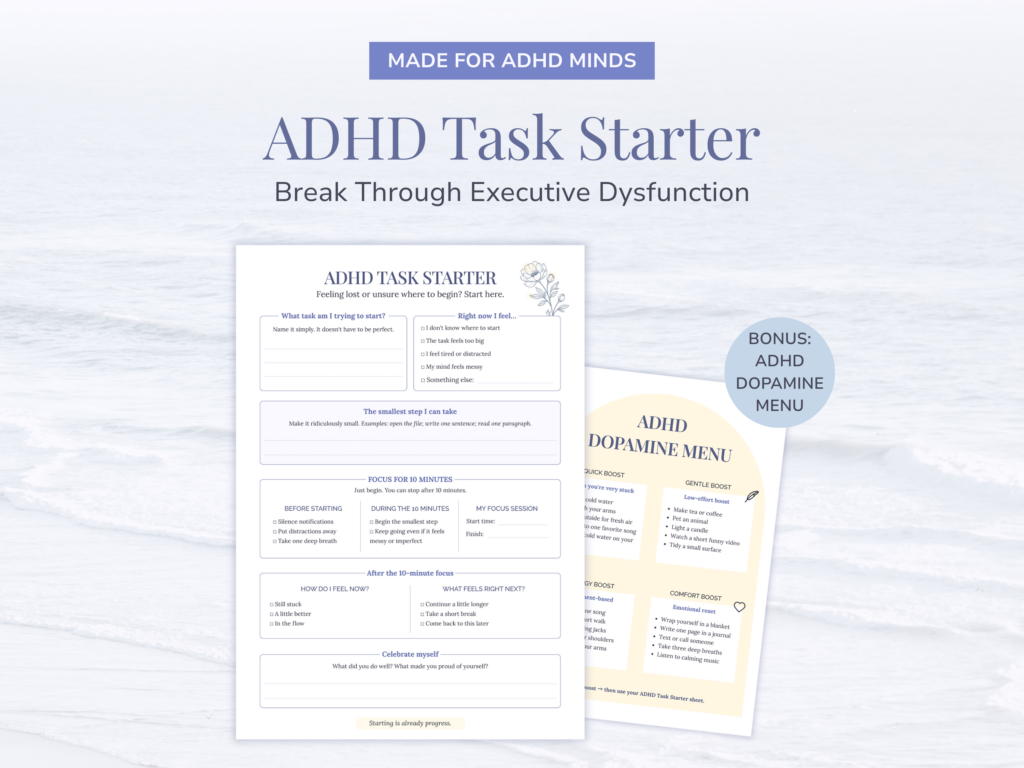
Get the ADHD Task Starter here and use it the next time your brain says “not now.”
Final Thoughts
If you’re struggling with ADHD task initiation right now, try not to be too hard on yourself. We all have moments when our brain resists things that feel stressful, uncomfortable, unclear, or painfully boring.
The goal is not to become someone who never procrastinates. The goal is to have a gentle way back into action when you get stuck. One small step is enough. Open the document. Send the email. Start the timer. Find the paper. Write the first messy sentence.
You don’t have to finish everything today. You just need one tiny way in.