
How to Plan Your Day with ADHD Without Creating a Rigid Schedule
26 June 2026
An ADHD daily schedule can sound like a good idea. You want more structure. You want to stop losing track of time. You want your day to feel less chaotic. So you try to plan everything properly.
Wake up at this time. Work during this block. Clean here. Rest there. Answer messages at 4 p.m. And for a moment, it feels reassuring. But then real life happens.
One task takes longer than expected. Your energy drops. Something interrupts you. You forget a transition. And suddenly, the whole schedule feels broken.
That’s why an ADHD daily schedule often works better when it is built around anchors instead of rigid time blocks. Not a perfect hour-by-hour plan. Just a few clear points in the day that help you know what matters, what can wait, and where to begin again.
In this article
Why a strict ADHD daily schedule can fall apart so quickly
A traditional daily schedule usually assumes your time, focus, and energy will behave in a predictable way. But ADHD and overwhelmed minds often don’t work like that.
You may underestimate how long a task will take. You may forget the time needed between two things. You may plan for your most motivated self, then feel guilty when your real energy doesn’t match the plan.
A strict schedule can quickly become another reason to feel behind. That doesn’t mean structure is useless. It means the structure needs to be lighter, more flexible, and easier to return to when the day changes.
If this pattern feels familiar, you might also like this post on why ADHD days fall apart without a clear anchor.
Start with a task dump before planning your day
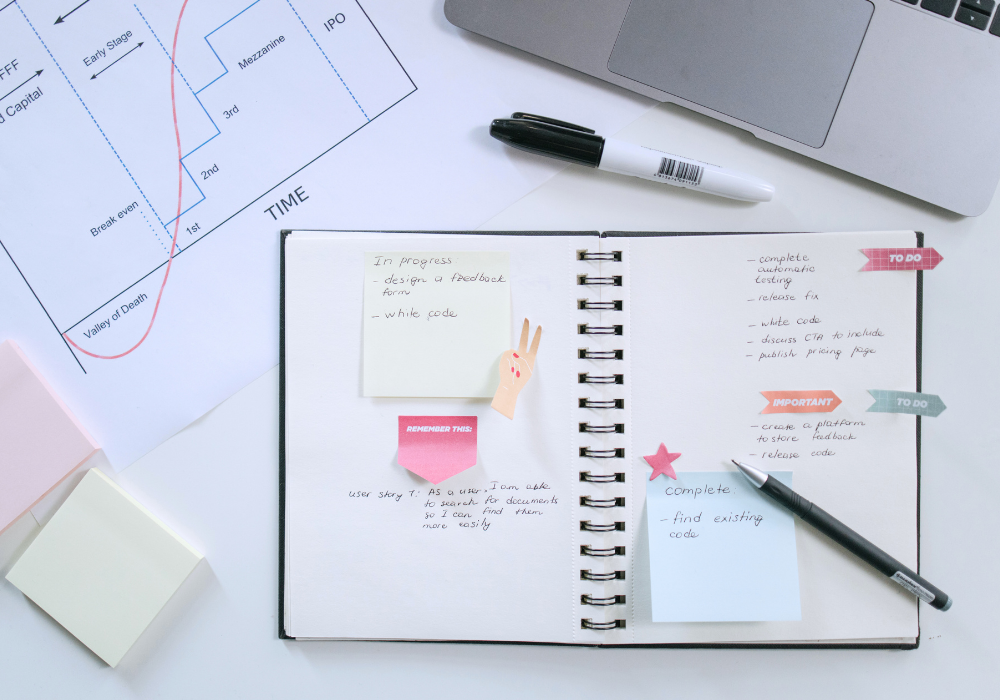
Before you build an ADHD daily schedule, start by getting the noise out of your head. Not perfectly. Not beautifully. Just honestly. Write down the tasks, reminders, errands, work things, home things, appointments, ideas, and small unfinished details taking up mental space.
This step matters because you cannot create a realistic daily plan while your brain is still trying to hold everything at once.
That’s why the ADHD Daily Anchors printable starts with a “From Task Dump to Daily Plan” page. Instead of asking you to plan your day immediately, it helps you first write down your tasks by category, such as home, admin, work, projects, and personal life.
Because sometimes the first step is not scheduling. It is seeing what is actually in your head.
Sort what belongs today, not everything you could do
Once everything is written down, the next step is not to do it all. The next step is to sort. A helpful ADHD daily schedule should not be a place where every task becomes urgent. It should help you decide what actually belongs in your day.
Try separating your tasks into simple groups:
- Today: things that truly need attention now
- This week: important, but not urgent today
- This month: tasks to plan later
- Later / not now: things that can safely wait
This is one of the most useful shifts for ADHD planning. You are not deleting tasks. You are not ignoring responsibilities. You are simply refusing to treat every task as if it has the same urgency.
The ADHD Daily Anchors printable uses this exact idea before you move into the daily pages, so your day starts from a smaller and more realistic list.
If weekly planning feels hard too, you can also read Weekly Planning for ADHD: A 10-Minute Method That Actually Feels Realistic.
Choose anchors instead of filling every hour
A rigid schedule tries to control the whole day. An anchor-based schedule gives your brain a few places to return to. For example, instead of planning every hour, you might choose:
- one morning anchor
- one midday anchor
- one evening anchor
These are not huge routines. They are simple check-in points. In the morning, you choose what matters. Around midday, you notice what needs adjusting. In the evening, you stop carrying the whole day in your head. This kind of ADHD daily schedule is easier to use because it leaves room for real life.
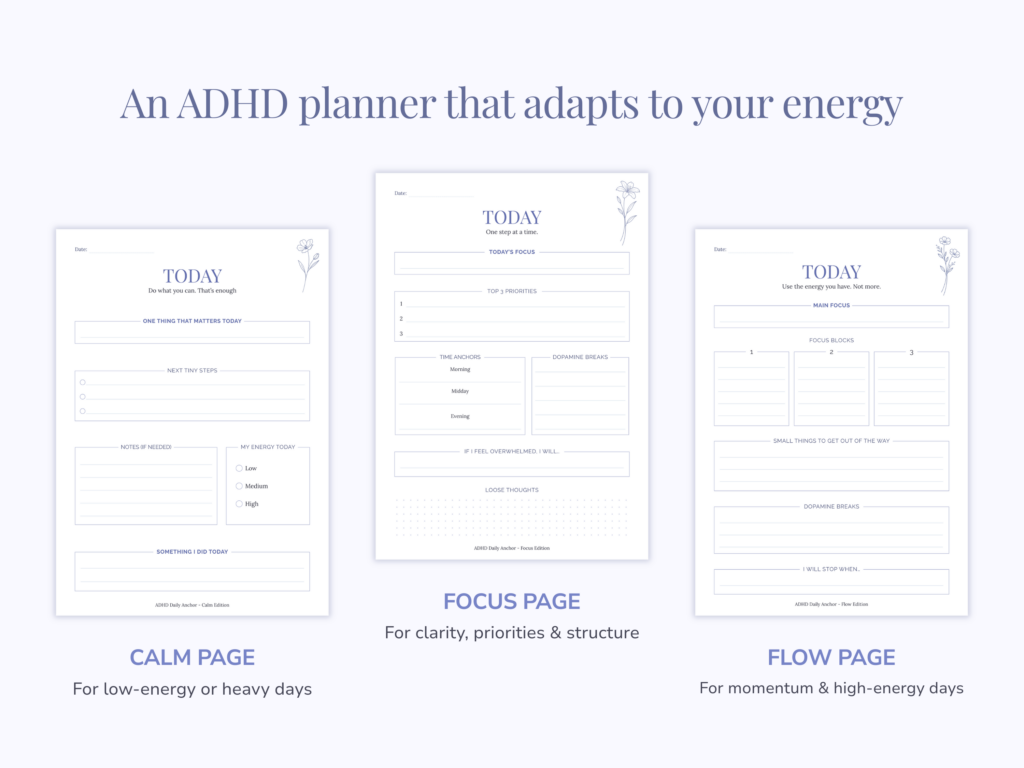
The Focus Edition of ADHD Daily Anchors includes time anchors for morning, midday, and evening, plus a daily focus, top 3 priorities, dopamine breaks, and a simple “if I feel overwhelmed, I will…” section. That is the kind of structure that can guide your day without trapping you inside a perfect plan.

Match your daily plan to your energy
One reason ADHD schedules become overwhelming is that they assume every day has the same capacity. But your energy is not always the same. Some days, you need calm. Some days, you need structure. Some days, you actually have momentum and want to use it well.
That’s why a realistic ADHD daily schedule should adapt to your energy instead of forcing you into the same format every day.
For a low-energy or overwhelmed day, your daily plan might be:
- one thing that matters
- three tiny next steps
- one small thing you did today
For a more focused day, it might be:
- today’s focus
- top 3 priorities
- time anchors
- dopamine breaks
For a higher-energy day, it might be:
- one main focus
- a few focus blocks
- small things to get out of the way
- a clear stopping point
This is also how ADHD Daily Anchors is structured: Calm Edition, Focus Edition, and Flow Edition, so you can choose the page that matches the day you are actually having. Not the day you wish you were having.
Don’t forget breaks and stopping points
A good ADHD daily schedule should not only tell you what to do. It should also help you stop. This matters because planning can easily turn into over-planning. You keep adding tasks. You keep trying to catch up. You keep pushing because you feel behind.
But if your plan has no breaks and no stopping point, it can become another source of pressure. Try adding:
- dopamine breaks
- a realistic pause
- one thing you will not do today
- a moment when you will stop
The Flow Edition of ADHD Daily Anchors includes dopamine breaks and a simple “I will stop when…” section. I love this because it reminds you that a useful plan is not just about starting. It is also about knowing when enough is enough.
If you often feel scattered during the day, you may also like this post on how to feel more grounded during the day when your mind keeps jumping.
A simple ADHD daily schedule you can try
Here is a simple way to plan your day without making it too rigid. First, empty your head. Then, sort your tasks into what belongs today, this week, this month, or later.
After that, choose the version of your day:
- Calm if you feel overwhelmed.
- Focus if you need structure.
- Flow if you have energy and momentum.
Then choose:
- one main focus
- one to three priorities
- a few time anchors
- one tiny first step
- one stopping point
That is enough. You do not need to map every hour. You do not need to plan a perfect routine. You do not need to become a completely different person by tonight. You just need a plan that helps you return to the day when your brain starts to drift.
If daily planning usually feels too rigid
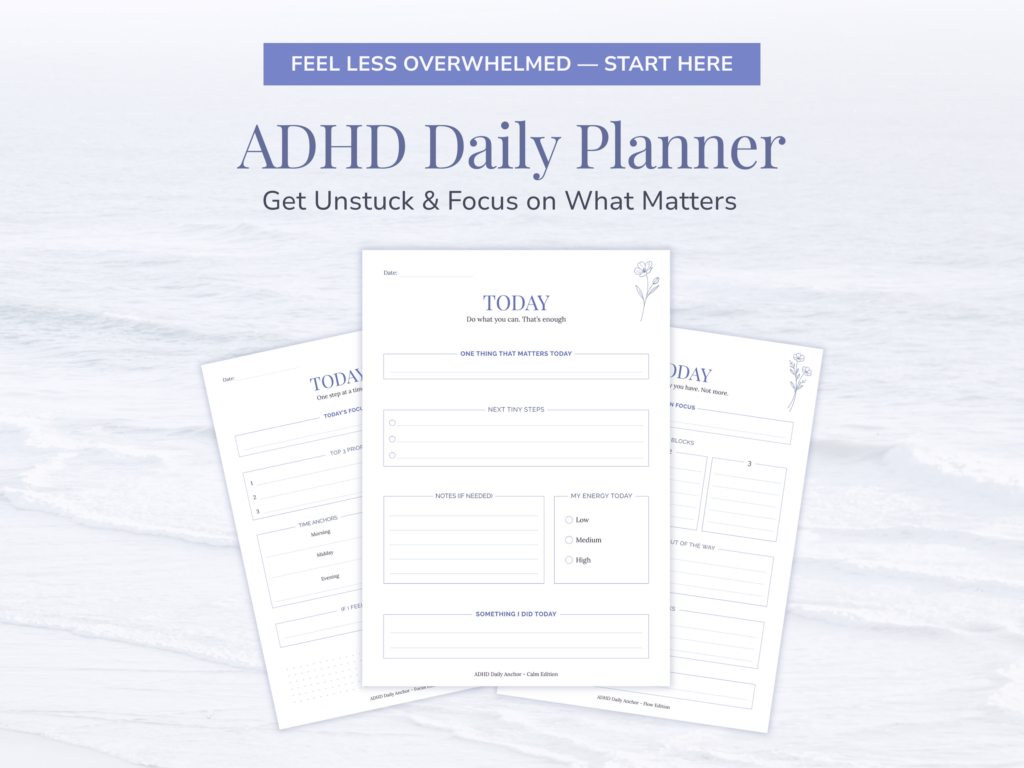
This is why I created the ADHD Daily Anchors. It is not a traditional daily planner that asks you to fill every hour or follow a perfect routine. It is a printable daily planning tool designed to help you move from scattered tasks to a simple plan for today.
You can start with a task dump, sort what actually belongs now, then choose a daily page based on your energy:
- Calm Edition when everything feels like too much.
- Focus Edition when you need clear structure.
- Flow Edition when you have more energy and want to use it without overdoing it.
The goal is not to control your whole day. The goal is to create enough clarity to begin, adjust, and come back when the day gets messy.
And if you are not sure what kind of overwhelm is making planning harder right now, you can also take the free overwhelm quiz. It can help you understand what your brain may need before you try to organize your day.
Final thoughts
An ADHD daily schedule does not have to be strict to be useful. In fact, the most helpful schedule may be the one that gives you less to fight against. A few priorities. A few anchors. A realistic first step. A place to come back to.
That is often enough to make the day feel less chaotic. Not perfect. Just possible.