

Brain Dump Worksheet: How to Brain Dump When Your Mind Feels Overwhelmed
25 May 2026
When your mind feels full of unfinished tasks, reminders, worries, appointments, ideas, and random thoughts, it can be hard to know where to start.
You may feel like everything is important. You may remember one task, then another, then something you forgot last week. And the more you try to think clearly, the more crowded your mind feels.
That is where a brain dump worksheet can help.
A brain dump is a simple way to get everything out of your head and onto paper before you try to organize it. Instead of asking your overwhelmed brain to remember, prioritize, and take action all at once, you give your thoughts somewhere to land first.
And if you have ADHD, feel easily overwhelmed, or struggle with executive dysfunction, a brain dump can be especially helpful because it removes the pressure to “think clearly” before you begin.
You do not need a perfect system. You just need a page, a few minutes, and permission to write messy thoughts down.
In this article, I’ll show you how to brain dump when your mind feels overwhelmed, how to sort what comes out, and how to use a simple brain dump worksheet without turning it into another stressful to-do list.
What Is a Brain Dump?
A brain dump is the process of writing down everything that is taking up space in your mind.
This can include:
- tasks you need to do
- things you are afraid of forgetting
- appointments
- deadlines
- ideas
- worries
- messages to send
- decisions you need to make
- things you keep postponing
- random reminders
- emotional thoughts
The goal is not to create a perfect to-do list immediately. The goal is to empty your mind first.
When everything stays in your head, it can feel like one big cloud of urgency. Once it is on paper, you can start to see what matters now, what can wait, and what does not need your energy today.

Why a brain dump worksheet can help when your mind feels full
A blank page can be helpful for some people. But when your mind already feels overwhelmed, a blank page can also feel too open. You may not know where to start, or you may write a huge messy list and feel even more stressed by everything you see.
That is why a brain dump worksheet can be useful. A structured brain dump worksheet gives your thoughts a simple container. It helps you unload everything first, then sort your thoughts into clearer sections.
This matters because mental clutter is not only made of tasks.
Sometimes your brain is holding reminders, worries, decisions, appointments, ideas, guilt, unfinished conversations, and things you are scared to forget.
And if you have ADHD or often feel overwhelmed by tasks, this mental clutter can quickly turn into task paralysis. Everything may feel equally urgent, even when some things can wait.
A brain dump helps because it separates the process into smaller steps:
- First, you write everything down.
- Then, you sort it.
- Then, you choose one next step.
That is much easier than asking your overwhelmed brain to magically know where to start.
You may also like: If your main struggle is starting once you know what to do, read: How to Start a Task When Your Brain Says “Not Now”.
How to Brain Dump in 5 Simple Steps
Here is a simple ADHD-friendly brain dump method you can use when your mind feels full, scattered, or overloaded.
1. Choose one brain dump worksheet, template, or page
Start with one place to write everything down. This can be a notebook page, a printable brain dump worksheet, a brain dump template, a digital note, or a planner page.
The important thing is to keep it simple. Do not open five different apps. Do not try to build a full productivity system. Do not make this harder than it needs to be.
When you are already overwhelmed, the first step needs to feel easy.
This is why a structured brain dump template can help. Instead of staring at a blank page and wondering where to begin, you already have a gentle space to unload your thoughts.
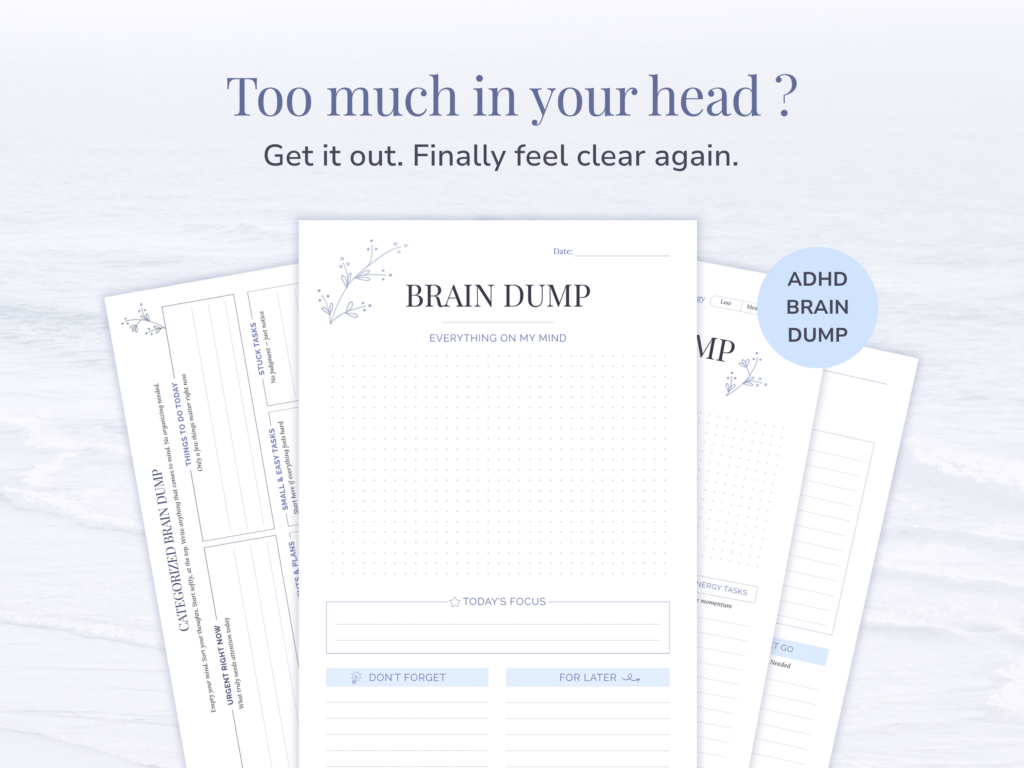
My ADHD Brain Dump printable includes different layouts depending on what your brain needs that day: a simple open brain dump, a priority-based brain dump, an energy-based brain dump, and a categorized brain dump worksheet.
So you do not have to force your brain into one perfect planning method. You can choose the page that feels easiest right now.
The only rule is this: everything goes in one place for now. You can organize it later.
2. Write everything down without sorting
Set a timer for 5 to 10 minutes and write down everything that comes to mind.
Do not filter. Do not sort. Do not ask, “Is this important enough to write down?” Do not try to make it look pretty.
If it is in your head, write it down.
Your brain dump might include things like “reply to email,” “buy shampoo,” “I feel behind,” “book appointment,” “laundry,” “project idea,” or “why am I so tired?”
That is normal. The page is allowed to be messy. A brain dump is not supposed to look organized immediately. It is supposed to help you unload the mental noise first.
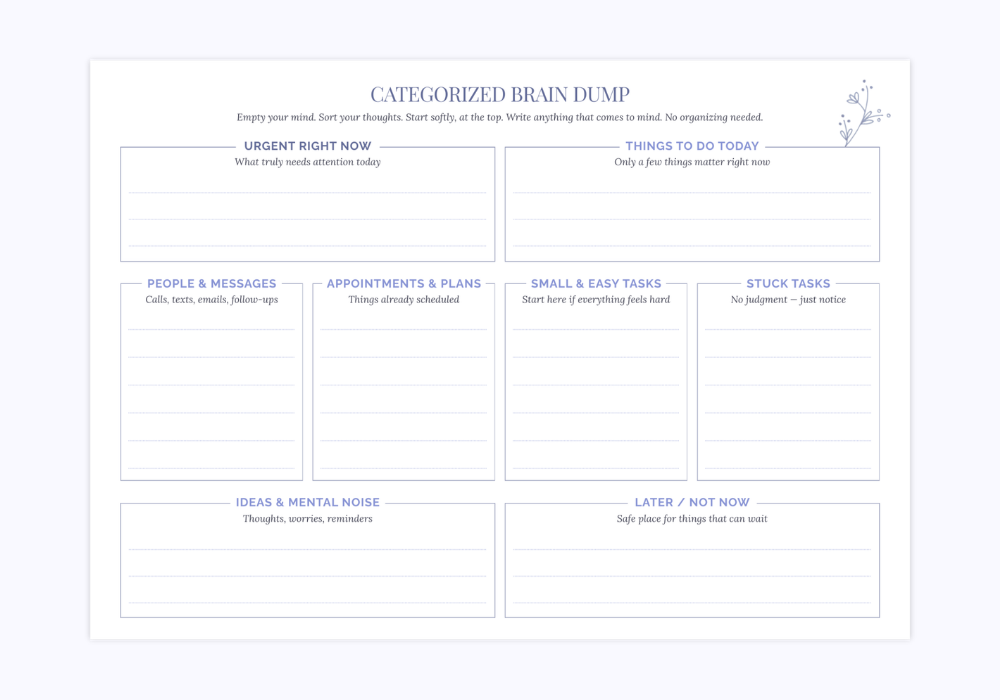
3. Sort your thoughts into simple categories
Once your thoughts are out of your head, you can start sorting them gently. You do not need a complicated system. Simple categories are enough.
You can use categories like:
- Do today
- Do soon
- Can wait
- Let go
- Messages
- Appointments
- Ideas
- Small easy tasks
- Needs more focus
This step helps you see that not everything in your mind is equally urgent. Some things need action today. Some things need a safe place to wait. And some things may not need your attention at all.
You may also like: If planning your week often feels overwhelming, try this simple ADHD weekly planning method after your brain dump.
4. Separate tasks from thoughts
Not everything you write down is a task. Some things are reminders. Some are worries. Some are decisions. Some are ideas. Some are emotions.
If you turn every single line into a task, your brain dump may become overwhelming again.
So before you create a to-do list, pause and ask:
- Is this something I need to do?
- Is this something I need to remember?
- Is this something I need to decide?
- Is this something I am worried about?
- Is this just a thought that needed somewhere to go?
For example, “I feel behind” is not a task. It may be a feeling. It may be a sign that you need to simplify your day. But it does not belong on your to-do list as one more thing to fix.
This small distinction can make your brain dump feel much safer and more useful.
5. Pick only 1 to 3 priorities
One of the biggest brain dump mistakes is turning the entire page into one giant to-do list. That usually creates more overwhelm.
After your brain dump, choose only 1 to 3 things to focus on next. Not ten. Not twenty. Not the whole page.
Your next step might be one urgent task, one small easy task, one message to send, one appointment to schedule, or one thing to move to later.
The point is not to finish everything. The point is to know what matters next.
You may also like: If your brain dump shows too many important things at once, this guide on how to set monthly priorities without overloading yourself can help you choose fewer things.
Brain Dump Prompts to Get Started
If you are staring at a blank brain dump worksheet, use these prompts:
- What am I afraid of forgetting?
- What tasks keep popping into my head?
- What appointments or deadlines are coming up?
- What messages do I need to send?
- What am I avoiding?
- What feels urgent?
- What is actually not urgent?
- What ideas do I want to save for later?
- What tiny task would make today feel lighter?
- What decisions am I carrying in my head?
- What am I worried about right now?
- What do I keep postponing?
You can also brain dump by life area:
- home
- work
- family
- health
- money
- appointments
- errands
- personal projects
- emotional worries
- ideas for later
There is no wrong way to do it.
The only rule is to get it out of your head before trying to organize it.

When Should You Use a Brain Dump Worksheet?
A brain dump worksheet can help when:
- your mind feels too full
- you feel overwhelmed by tasks
- you cannot decide where to start
- you feel scattered
- you are procrastinating because everything feels like too much
- you keep forgetting small tasks
- you feel mentally stuck
- you are trying to plan your day or week
- you are dealing with decision fatigue
You can use a brain dump in the morning, at the end of the day, before planning your week, before a busy season, or anytime your brain feels cluttered.
It can also be useful when you feel emotionally overloaded but do not know exactly why.
Sometimes, seeing your thoughts on paper helps you realize that your brain has been carrying much more than you thought.
Not sure what kind of overwhelm you are dealing with right now? Take the free overwhelm quiz to find the support that fits your brain best.
Try an ADHD Brain Dump Printable
If a blank page feels too open or overwhelming, a structured brain dump worksheet can make it easier to begin.
The ADHD Brain Dump printable was designed to help you get everything out of your head, then gently sort what came out without turning it into a rigid productivity system.
You can choose the layout that fits your brain that day: an open brain dump, a priority-based page, an energy-based page, or a categorized worksheet for thoughts, tasks, reminders, appointments, and mental noise.
Use it when your mind feels full, your tasks feel scattered, or you need one gentle place to start.
Explore the ADHD Brain Dump printable here ⬇️
Final Thoughts
Learning how to brain dump is not about becoming perfectly organized overnight.
It is about creating a simple pause between mental chaos and your next step.
You write everything down. You sort it gently. You choose what matters now. You let the rest wait.
Your brain does not have to hold everything at once.