

The Missing Step Between “Writing Things Down” and Actually Doing Them
8 May 2026
If you have ADHD, chances are you have done at least one massive brain dump before. Maybe on a random notebook page. Maybe in a planning app. Maybe on twenty different sticky notes scattered around your desk.
At first, it feels good. Relieving, even. Because everything that was spinning around in your head is finally out. But then… nothing happens.
You stare at the list. You feel overwhelmed all over again. And instead of helping you move forward, the brain dump becomes just another giant wall of unfinished things.
If that sounds familiar, you are not failing. The truth is: writing everything down is only the first step.
Brain Dumps Are Helpful… But Incomplete
A lot of ADHD advice stops at: “Get it out of your head.” And honestly? That part does matter.
Mental clutter is exhausting. Carrying dozens of reminders, worries, tasks, and ideas in your head all day drains an incredible amount of energy.
But many people discover something frustrating after doing a brain dump: they still do not know what to do next. Because now the overwhelm is no longer inside their brain. It is sitting right in front of them on paper.
The Real Problem Is Not Laziness
Usually, the problem is one of these:
- Everything feels equally urgent
- Tasks are too vague or too big
- You do not know where to begin
- Your brain cannot prioritize clearly
- The list feels emotionally intimidating
- You are already mentally exhausted before starting
And when that happens, the brain often freezes. Not because you do not care. Not because you are lazy. But because your nervous system is overloaded.
This is why so many people end up doing “productive” things around the tasks instead of actually starting them:
- Rewriting the list
- Color coding
- Opening planners
- Researching systems
- Organizing instead of acting
It feels like progress. But deep down, you still feel stuck.

The Missing Step Is Translation
A brain dump is not an action plan. It is raw mental material. The missing step is learning how to translate overwhelm into something your brain can realistically act on.
That means:
- Sorting without pressure
- Deciding what actually matters today
- Letting some things wait
- Turning vague projects into visible next steps
- Making tasks small enough to start without resistance
Because the truth is: your brain does not need a perfect master plan right now. It needs clarity. And clarity usually comes from simplification.
Tiny Steps Change Everything
One of the biggest shifts for me was realizing that huge tasks create huge resistance. “Clean the house.” “Fix my life.” “Get organized.” “Work on the project.”
Those are not actionable tasks for an overwhelmed ADHD brain. They are emotional mountains.
Tiny steps work differently. Instead of “work on taxes”, you get:
- Open laptop
- Find tax folder
- Read first document
- Highlight missing information
Suddenly, the task becomes less threatening. Tiny steps reduce friction. And reduced friction makes action possible. That is why “one thing at a time” matters so much.
Not because you are incapable. But because overwhelmed brains struggle when they are forced to hold too many moving parts at once.

You Do Not Need to Do Everything Today
This is another important shift. A lot of overwhelmed people secretly believe: “If I cannot do everything, there is no point starting.”
But progress rarely works like that. Sometimes success looks like:
- Choosing one realistic priority
- Completing one tiny task
- Reducing one layer of mental chaos
- Making tomorrow easier
- Moving forward calmly instead of forcing productivity
That still counts. Actually, for many ADHD brains, that approach works better long term than constantly trying to do everything at once.
What If Your To-Do List Could Actually Lead to Action?
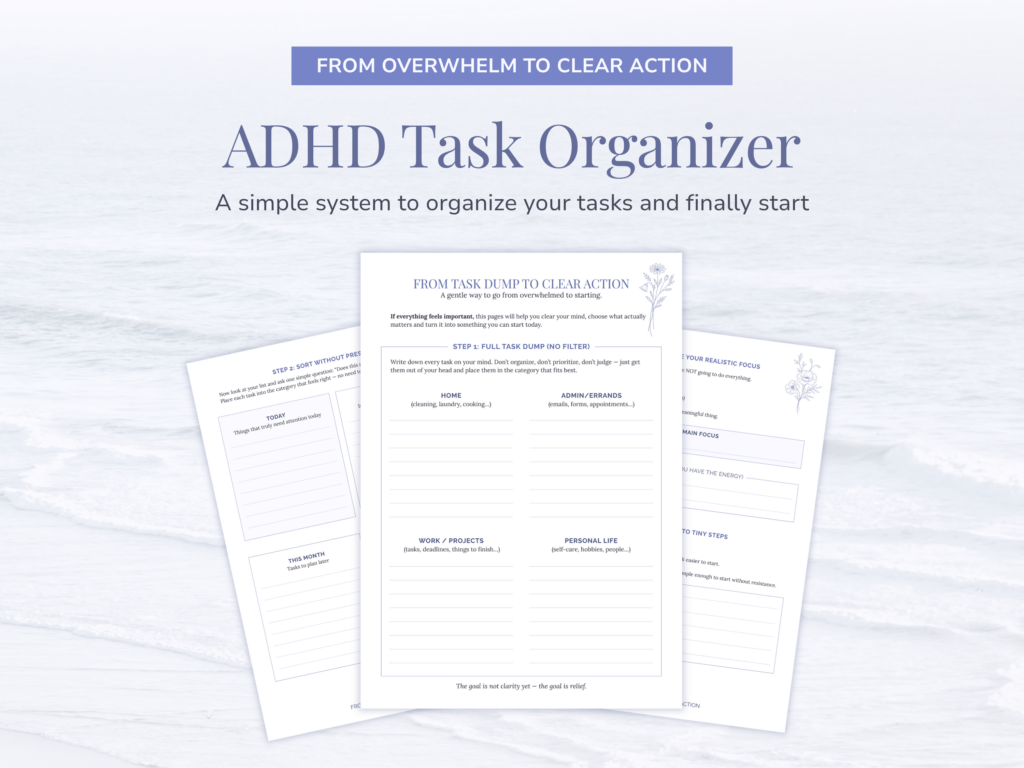
That is exactly why I created ADHD Task Organizer. Instead of stopping at the brain dump stage, this printable gently guides you through the missing middle steps that help overwhelmed tasks become clear, manageable action.
Through a simple 5-step process, it helps you:
- Empty your mind without filtering
- Sort tasks without pressure
- Choose a realistic focus
- Break things into tiny, easy-to-start steps
- Decide what you will actually do today
Not perfectly. Not all at once. Just calmly, clearly, and one step at a time.
Final Thoughts
If your brain dumps keep turning into giant overwhelming lists, it does not mean planning “doesn’t work” for you. It probably means nobody taught you what comes after the brain dump.
Because the real goal is not to create the perfect list. The goal is to create enough clarity that your brain can finally stop spinning and start moving again.
Slowly. Gently. One tiny doable step at a time.