

What to Do After a Stressful Day When Your Mind Won’t Let Go
24 April 2026
The day is over. You’re finally home. Things are quieter. But your mind… isn’t.
It keeps replaying conversations. Going over what you said, what you didn’t say. Thinking about everything that’s still unresolved.
You tell yourself: “It’s done. Let it go.” But it doesn’t let go. And instead of resting, you stay stuck in it.
If this happens to you, it’s not because you’re overthinking for no reason. It’s because your mind hasn’t had a chance to process what happened.
Step 1: Stop Trying to Switch It Off
The first reflex is often to escape it. Scrolling. Distracting yourself. Trying not to think about it. Or the opposite — forcing yourself to calm down.
But neither really works. Because your mind isn’t holding on to the day randomly. It’s holding on because something hasn’t been processed yet.
So instead of asking: “How do I stop thinking about this?”, try something softer: “What is my mind trying to hold onto?”.
Step 2: Let It Out (Even If It’s Messy)
Before anything can settle, it needs space. Not organized. Not structured. Just… out.
You can write:
- everything that’s looping
- what bothered you
- what felt unfair, heavy, confusing
Even if it doesn’t make sense. Even if it’s repetitive. This isn’t about solving anything. It’s about taking it out of your head so it stops circling inside it.

Step 3: Gently Bring Clarity Back
Once things are out, something shifts. Not everything feels as intense anymore.
From there, you can begin to separate:
- what actually happened
- what you felt about it
And sometimes, you’ll notice that what’s heavy isn’t just the situation — but everything your mind added on top of it. This step isn’t about correcting yourself. It’s about seeing more clearly.
Step 4: Put Down What Isn’t Yours to Carry
After a stressful day, your mind often holds onto things that aren’t fully yours to solve. Other people’s reactions. Things you can’t control anymore. What might happen next.
You don’t need to resolve all of it. You can simply ask:
- what can I actually act on?
- what is outside of my control right now?
And gently… put the rest down. Not forever. Just for tonight.

Step 5: Come Back to Something That Feels Safe
At this point, your mind might still be active — but less intense. Now you don’t need to fix anything. You just need to come back to yourself.
Something simple is enough:
- a slower breath
- relaxing your shoulders
- dimming the lights
- sitting in silence for a minute
Small signals that tell your body: “The day is over. You can soften now.”
When It Still Won’t Let Go
Some days are heavier. And even after trying to slow down, your mind keeps going. That’s not failure. That just means you need a little more support to move through what you’re holding.
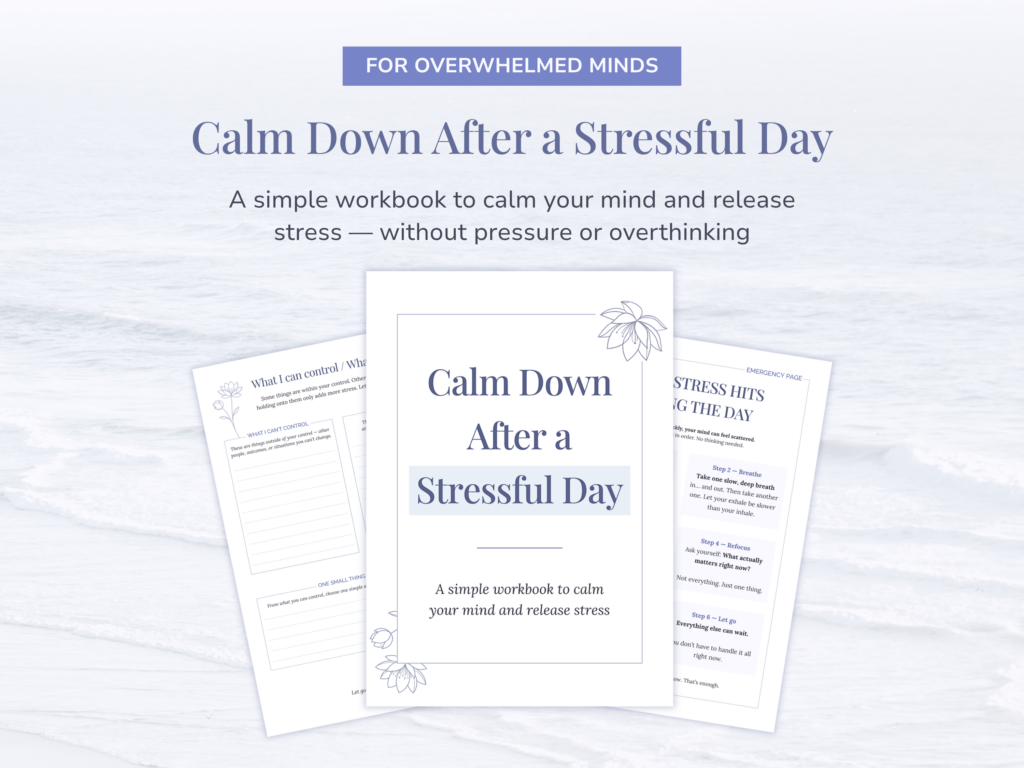
The Stress Relief Workbook was designed for exactly these moments. Not to fix your day. Not to force calm. But to guide you gently through it.
It helps you:
- release what’s stuck in your mind
- separate thoughts from emotions
- understand what’s actually yours to carry
- and shift toward small, manageable next steps
You don’t have to figure it all out. You just need a space that helps you process, at your own pace.
If your mind won’t let go at the end of the day, it’s not because you’re doing something wrong. It’s because something inside you hasn’t had space to be processed yet.
You don’t need to shut it down. You don’t need to push it away. You just need to give it somewhere to go.
And from there, letting go becomes a little easier.