

ADHD Overstimulation: Why Everything Feels Too Much and How to Calm Down
22 June 2026
ADHD overstimulation can make ordinary moments feel suddenly impossible.
The room feels too loud. Your phone keeps buzzing. Someone asks you one more question. Your clothes feel uncomfortable. Your thoughts are moving too fast. And even though nothing “dramatic” is happening from the outside, inside your body and mind, everything feels like too much.
If this sounds familiar, you are not being too sensitive. You are not making a big deal out of nothing. Your brain may simply be overloaded.
And when you are already overwhelmed, the answer is not to push harder, force yourself to focus, or pretend you are fine.
Sometimes, the kindest first step is to reduce the noise, slow down, and give yourself a way back to calm.
In this article
What ADHD Overstimulation Can Feel Like
ADHD overstimulation does not always look obvious from the outside. You might still be answering messages, making dinner, working, caring for others, or trying to keep going. But inside, your nervous system may feel like it has reached its limit.
It can feel like:
- every sound is too loud
- small interruptions feel unbearable
- your thoughts are moving too quickly
- you cannot decide what to do next
- your body feels tense or restless
- you suddenly feel irritated, tearful, or exhausted
- you want to hide, scroll, shut down, or disappear for a moment
- simple tasks feel harder than they should
Sometimes, ADHD overstimulation looks like snapping at someone you love. Sometimes, it looks like freezing in front of a task. Sometimes, it looks like needing silence after a normal day. And sometimes, it looks like feeling completely drained without understanding why.
Why Everything Can Feel Too Much So Quickly
When you have ADHD or an easily overwhelmed brain, your mind may be trying to process too many things at once. Not just the obvious things, like noise, screens, messages, or clutter. But also:
- unfinished tasks
- decisions waiting to be made
- appointments to remember
- emotions you have not processed yet
- background worries
- transitions between activities
- other people’s needs
- the pressure to “keep up”
That is a lot for one brain to hold. Resources on ADHD and sensory overload explain that sensory input and self-regulation can be harder to manage for many people with ADHD. But in real life, this does not always feel like a neat explanation. It often feels like: “I can’t take one more thing.”
And that is the part that matters. Your brain is not failing because it needs less input. Your body is not wrong because it asks for quiet. You are not weak because you need a pause. You may just be overloaded.

ADHD Overstimulation Is Not You Being Dramatic
One of the hardest parts of ADHD overstimulation is the guilt that can come with it. You may think:
- “Why am I reacting like this?”
- “Other people seem fine.”
- “This should not be so hard.”
- “I should be able to handle more.”
But overstimulation is not a character flaw. It is not laziness. It is not immaturity. It is not you being dramatic. It is often a sign that your brain and body have been carrying too much input for too long.
And when everything feels too much, you do not need to shame yourself into doing better. You need to create a little less pressure. Not a perfect reset. Not a full life overhaul. Just enough space to breathe again.
You may also like: If your overstimulation often turns into freezing, read this next: ADHD Task Paralysis: Why You Freeze Instead of Starting.
What to Do When You Feel Overstimulated
When you are overstimulated, complicated advice usually does not help. You do not need a long routine. You do not need to understand everything immediately. You need simple steps that lower the pressure. Here are a few gentle ways to begin.
1. Reduce one source of input
Start by removing one thing that is adding noise. Not everything. Just one thing.
You could:
- put your phone on silent
- turn off the TV
- dim the lights
- step into another room
- close extra tabs
- put on softer clothes
- pause the conversation for a few minutes
- lower background noise
The goal is not to create a perfect calm environment. The goal is to give your brain slightly less to process. One small reduction can already help your body feel safer.
2. Get the mental noise out of your head
Sometimes overstimulation is not only sensory. It is mental. Your brain may feel full of tasks, reminders, worries, unfinished thoughts, and things you are afraid to forget.
When that happens, writing things down can help. You do not need to organize anything at first. Just let the noise out.
Write:
- what is bothering you
- what you are trying to remember
- what feels urgent
- what you are worried about
- what feels too much right now
This is not about making a perfect to-do list. It is about giving your brain somewhere to put what it has been carrying.
You may also like: If your mind feels full of tasks and reminders, start here: Brain Dump Worksheet: How to Brain Dump When Your Mind Feels Overwhelmed.
3. Separate what is real from what feels loud
When you are overstimulated, everything can feel urgent. But not everything IS urgent.
A helpful question is: “What is actually happening right now?”. Then ask: “What am I feeling about it?”
For example:
- Fact: I have three emails to answer.
Feeling: I am behind and everyone is waiting for me.
- Fact: The kitchen is messy.
Feeling: I am failing at everything.
- Fact: I have a task to start.
Feeling: I will never manage this.
Both things matter. Your feelings are real. But they are not always the full picture. Separating facts from feelings can help you see the situation more clearly, without dismissing what you feel.

4. Choose one tiny next step
When everything feels too much, your next step needs to be small. Smaller than you think.
- Instead of “clean the whole room,” try “pick up five things.”
- Instead of “catch up on everything,” try “open the list.”
- Instead of “finish the project,” try “write the first sentence.”
- Instead of “fix my life,” try “drink water and sit down for two minutes.”
A tiny next step may feel almost too simple. That is the point. When your brain is overloaded, simple is not lazy. Simple is how you begin again.
5. Let your body come back to the present
ADHD Overstimulation is not only in your thoughts. It can live in your body too. Your shoulders may be tight. Your jaw may be clenched. Your breathing may feel shallow. Your whole body may feel like it is bracing.
A gentle body reset can help you come back to the present moment. You can try:
- taking three slower breaths
- unclenching your jaw
- dropping your shoulders
- pressing your feet into the floor
- stretching your hands
- placing one hand on your chest
- noticing five things you can see
You do not have to feel instantly calm. You are simply reminding your body that it does not have to hold everything at once.
When You Need More Than “Just Take a Break”
Sometimes, taking a break is not enough. You can sit down, close your eyes, put your phone away… and still feel the stress sitting in your chest. Because what you need is not only silence. You need somewhere for everything to go.
The thoughts. The tension. The guilt. The “I don’t even know what I feel right now.” The tiny things that became too heavy after a long day.
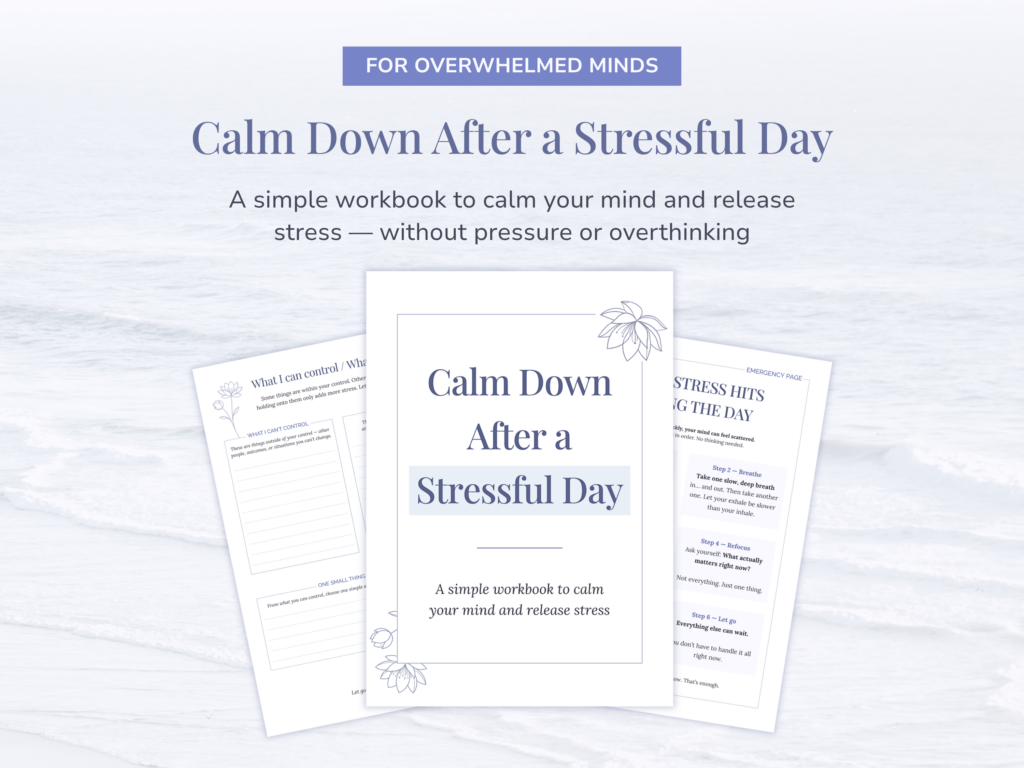
That is what the Stress Relief Workbook is for.
It gives you a calm, guided space to slow down and untangle what feels heavy, one page at a time. You can use it to let your thoughts out, separate what happened from what you are feeling, notice what is actually in your control, and choose one small step that feels manageable.
There are also simple grounding, breathing, and body-based exercises for the moments when stress is not just in your mind, but in your shoulders, your jaw, your chest, or your whole body.
You do not need to complete the whole workbook in one sitting. You can open one page. Use one exercise. Take one breath. Come back to yourself slowly.
Explore the Stress Relief Workbook here ⬇️
Not Sure What Kind of Overwhelm You Are Dealing With?
Sometimes, it is hard to know what you need because everything feels tangled together.
- Maybe you need less noise.
- Maybe you need to get your thoughts out.
- Maybe you need a softer plan.
- Maybe you need help starting.
- Maybe you just need a moment to breathe.
If you are not sure where to begin, you can take the free 2-minute ADHD quiz to better understand what might help you feel more organized and supported right now.
Final Thoughts
ADHD overstimulation can make you feel like you are failing at ordinary life. But you are not failing. Your brain may be tired. Your body may be asking for quiet. Your mind may be holding too much at once.
You do not need to fix everything today. Start by reducing one source of input. Write down what is in your head. Choose one tiny next step. Let your body soften, even a little.
You are allowed to need calm. You are allowed to pause. You are allowed to come back to yourself slowly.