

ADHD Weekly Planner: 7 Powerful Reasons Daily Lists Fail
7 July 2026
ADHD weekly planner might sound like just another productivity tool, but for an overwhelmed ADHD brain, it can make the difference between staring at a chaotic daily to-do list and finally seeing your week clearly.
Because daily to-do lists can feel helpful for approximately 12 minutes. You write everything down. You feel a little more in control. You think, “Okay, this is the day I finally become organized.”
And then real life enters the chat. One appointment takes longer than expected. One task secretly has 17 steps inside it. One message interrupts your focus. Suddenly, your simple daily list feels less like support and more like a tiny paper version of judgment.
The problem is not that you are bad at planning. The problem may be that your brain needs more than a daily list. It may need a weekly view.
That is where an ADHD weekly planner can help. Not a rigid, color-coded, military schedule. Absolutely not. We are not trying to become a productivity robot before breakfast.
An ADHD weekly planner simply gives your brain a calmer map of the week, so you can see what is already happening, what actually matters, and where you need space.
In this article
1) A daily list does not show the whole picture
Daily to-do lists show you what is happening today. But they often hide the bigger context.
They do not show that yesterday drained you. They do not show that tomorrow is already packed. They do not show that this “quick task” actually involves finding a document, making a phone call, leaving the house, recovering emotionally, and possibly needing a snack.
An ADHD weekly planner helps you zoom out before you decide what belongs in one day. Instead of planning from one tiny slice of time, you can see the shape of your whole week.
2) Everything feels equally urgent
When you have ADHD, a daily list can quickly become one big pile of “DO THIS NOW.”
- Answer the email.
- Clean the kitchen.
- Book the appointment.
- Start the project.
- Fold the laundry that has now become part of the furniture.
Everything sits there, shouting for attention.
An ADHD weekly planner helps you separate what is urgent, what is important, what is optional, and what can absolutely wait without the world collapsing. Very reassuring. Very necessary.

Read next: Why ADHD Organization Fails When Everything Is Treated the Same Way.
3) A weekly view helps you see your real capacity
A daily list can make five tasks look perfectly reasonable. But a weekly view shows you that those five tasks are happening inside a week that already includes appointments, errands, family life, transitions, low-energy moments, and 42 invisible responsibilities.
This is why an ADHD weekly planner can feel so much calmer. It helps you ask: “What can actually fit into this week?” Not: “What could I do if I suddenly became a new woman with unlimited focus and no need for rest?”
The version of you with unlimited energy is not the one who has to live this week. You do.
4) Fixed plans stop disappearing from your brain
Appointments, meetings, school things, calls, deadlines, errands — they take up more space than they seem. Not just time. Mental energy too.
A weekly planner for ADHD lets you place those fixed plans first, before adding more tasks around them.
That way, you can see that Thursday is already heavy, Monday needs breathing room, and Friday should probably not become the “catch up on my entire life” day.
For more help with realistic daily planning, you can read How to Plan Your Day with ADHD Without Creating a Rigid Schedule.
5) Bigger tasks become easier to break down
Daily lists often hide the real size of a task. “Organize the house” sounds like one task. It is not one task. It is a trap.
A better ADHD weekly planner helps you turn big, vague tasks into tiny next steps. Instead of writing: “Organize the house”, you might write: “Clear the kitchen counter for 10 minutes.”
That is much easier for your brain to accept. Tiny steps are not lazy. They are often the difference between starting and spiraling.

6) You can leave space for low-energy days
A helpful ADHD weekly planner does not assume you will feel the same every day. Because you will not. Some days your brain is ready. Some days everything feels foggy. Some days the goal is simply to keep the basics moving without adding shame on top.
A weekly view lets you leave white space on purpose. White space is not wasted space. It is where delays, emotions, transitions, family life, rest, and “why did this take three times longer than expected?” can exist.
Real life needs room. Annoying, but true.
7) You can reset without turning it into self-criticism
A weekly planner is not only helpful at the beginning of the week. It can also help you reset at the end. Not in a dramatic “why did I fail again?” way.
More like:
- What worked?
- What felt too heavy?
- What needs to move?
- What did I actually do, even if my brain immediately forgot it?
An ADHD weekly planner gives you a gentle way to notice progress, adjust, and begin again without turning your week into a courtroom.
If your whole month already feels messy, you might also like How to Reset Your Month When You Already Feel Behind.
A Gentle ADHD Weekly Planner in Google Sheets
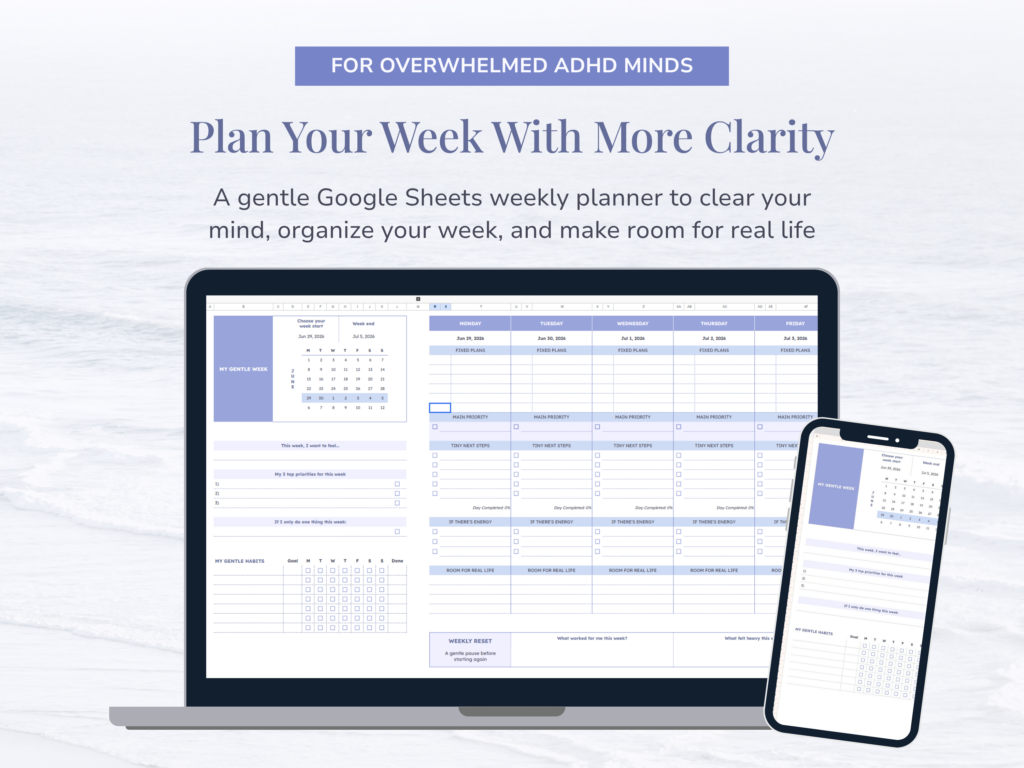
If you want a calmer way to see your week, I created the ADHD Weekly Google Sheet. It is an ADHD weekly planner in Google Sheets designed for overwhelmed minds who need structure without pressure.
It includes a brain dump section, weekly priorities, fixed plans, one main priority per day, tiny next steps, optional “if there’s energy” tasks, room for real life, a gentle habit tracker, and a weekly reset section.
It is not a complicated productivity dashboard. It is a one-tab weekly planning space to help you clear your mind, choose what actually belongs in your week, and build a plan that makes room for real life.
You only need a free Google account to use it. After purchase, you receive a PDF with the access link, make your own editable copy, and duplicate the weekly tab whenever you want to start a new week.
And gentle reminder: you do not need to fill in every box. Use what helps. Leave what does not. Your planner is here to support your brain, not give you more things to feel behind on.
Final Thoughts
If daily to-do lists keep making you feel scattered, behind, or weirdly attacked by your own plans, you may not need a stricter schedule. You may need a wider view.
An ADHD weekly planner helps you see your week before you overload it. It helps you protect your energy, choose realistic priorities, and remember that productivity is not the goal at any cost.
Your week does not need to be perfect. It just needs to be visible enough for you to find your next step.