

ADHD Weekly Planning: How to Stop Starting Every Week From Scratch
14 July 2026
ADHD weekly planning can feel strangely exhausting when every Monday asks you to start from zero again. A clean page. A fresh weekly view. A new chance to become organized, focused, calm, realistic, hydrated, and magically caught up on everything. Very cute.
And then you look at the blank page and realize something uncomfortable: Your week is not actually starting from scratch. There are tasks from last week still floating around. There are things you meant to finish but did not. There are notes you wrote down that now make absolutely no sense. There are emails, appointments, reminders, ideas, and tiny unfinished life admin goblins waiting quietly in the background.
So instead of feeling fresh, the new week feels weirdly heavy. You are not only planning what comes next. You are also trying to remember where you left off.
And if you have ADHD, that can be one of the hardest parts of weekly planning. Not because you do not care. Not because you are lazy. Not because you need to “just be more disciplined.”
But because many weekly planning systems are built around a blank-page fantasy. They assume each week is separate. Real life is not separate. ADHD brains definitely do not experience life in neat weekly folders.
What you need is not a perfect fresh start every Monday. You need a way to keep the thread.
In this article
Why ADHD weekly planning can feel so hard
A blank weekly planner page can look peaceful. Until your brain realizes it has to rebuild the entire week from memory.
- What did I not finish last week?
- What was I supposed to follow up on?
- Was that task actually important?
- Why did I write “call them” with no name, no number, and no emotional context?
- Who is “them”?
- Was I okay?
This is where ADHD weekly planning can quickly become overwhelming. A traditional weekly planner often focuses on what is coming next: appointments, deadlines, priorities, plans, maybe a nice little habit tracker that will be abandoned by Wednesday.
But it does not always help you connect the current week to the previous one. So every Monday, you end up doing mental archaeology.
- You search through old lists.
- You reopen tabs.
- You scan last week’s planner.
- You try to remember what Past You meant.
- You feel behind before the week has even started.
The problem is not the weekly planner itself. The problem is that a blank page gives your brain no continuity. And for ADHD brains, continuity matters. Because when the thread disappears, the task often disappears too.
Or worse: the task stays in your head as vague guilt, but not as a clear next step. Delightful system. Very efficient. No notes.
Why ADHD Weekly Planning Needs Continuity Between Weeks
Most weekly planning advice says something like: “Choose your priorities for the week.” Which is helpful. But it skips the part where you are supposed to know what your priorities are when your brain is holding seventeen unfinished thoughts and one mysterious sense of doom.
Before you can plan the new week, you often need to reconnect with the old one.
That does not mean doing a full weekly reset. It does not mean writing a deep review of your entire life. It does not mean judging everything you did or did not do. It simply means asking: What is still open?
That one question changes the whole energy of ADHD weekly planning. Instead of pretending last week never happened, you gently look at what is unfinished and decide what deserves to come with you.
Some things will move forward. Some things will wait. Some things will become smaller. Some things will be released because they were never that important in the first place. This is the difference between starting over and continuing.
Starting over says: “Let’s forget everything and try again.” Continuing says: “Let’s see where we actually are and take the next step from there.” For ADHD planning, that is much kinder. And honestly, much more useful.

What a carry-over system does differently
A carry-over system is simply a way to move unfinished tasks from one week to the next without dragging the whole emotional suitcase with them. Because unfinished tasks can get weirdly heavy.
At first, it is just: “Send email.” Then it becomes: “Send email, which I should have sent four days ago.” Then: “Send email, which now proves I am terrible at managing my life.” And suddenly, one tiny email has become a full personality trial.
A carry-over system helps you stop treating unfinished tasks like evidence against you. Instead, you look at each task and make a decision. Not every unfinished task needs to move into the new week.
- Some tasks still matter.
- Some tasks need to be broken down.
- Some tasks are waiting for information.
- Some tasks are not urgent anymore.
- Some tasks can be deleted with peace and dignity. Goodbye, random idea from last Tuesday.
The goal is not to copy your old to-do list into a new box. That just gives your guilt a nicer layout. The goal is to decide what happens next. You can sort unfinished tasks into four simple categories:
- Do this week: For tasks that still matter and need your attention soon.
- Make smaller: For tasks that feel too big, vague, or emotionally spicy.
- Park for later: For tasks that matter, but not this week.
- Let go: For tasks that no longer deserve your energy.
This is where an ADHD weekly planner becomes more than a list. It becomes a filter. And when your brain is overwhelmed, a filter is often more helpful than another giant list.
How to carry over unfinished tasks without feeling behind
The key is to stop asking: “What did I fail to finish?” That question is rude. We do not like her. Ask this instead: What is still worth carrying forward?
That wording matters. It removes some of the shame and brings you back to decision-making. When you review unfinished tasks, try not to automatically move everything into the new week. That is how one task ends up haunting you for six weeks while silently judging you from the bottom of your planner.
Instead, go one by one. For each task, ask yourself:
- Does this still matter?
- Does it need to happen this week?
- Is it clear enough to start?
- Can I make it smaller?
- Can I park it?
- Can I let it go?
For example:
- “Organize my files” might become “delete 10 downloads.”
- “Work on blog” might become “choose one keyword.”
- “Clean the house” might become “clear the kitchen counter.”
- “Sort my life out” might become… absolutely not. Too broad. Illegal.
A task that is too big will often keep being carried over because your brain does not know where to enter. So the carry-over moment is also a simplification moment. You are not just moving the task. You are making it easier to restart.
For the moment when the task is clear but starting still feels impossible, this article, How to Start a Task When Your Brain Says “Not Now”, goes deeper into that first-step resistance.
A simple ADHD weekly planning setup to keep continuity
Your ADHD weekly planning system does not need twenty sections. In fact, the more complex it is, the more likely it is to become a beautiful abandoned document.
A useful weekly planner for ADHD should help you see what is coming up, what is still open, what matters most, what can wait, and what the next step is.
That is enough. Here is a simple setup you can use.
1) A carry-over section
This is where you write the tasks, reminders, or loose ends from last week that still matter. Not all of them. Only the ones you intentionally choose to carry forward.
This section helps your brain stop relying on memory alone. Because memory is lovely, but she is not always invited to manage the calendar.
2) A weekly view
This is your basic overview of appointments, deadlines, and fixed commitments. The goal is not to fill every space. The goal is to see the shape of the week.
For ADHD brains, seeing the week visually can help reduce that blurry feeling where every task seems equally urgent and somehow also impossible to begin.
3) A weekly priorities section
Choose a few priorities for the week. Not twelve. Not “everything I avoided last month.” Not “become a new woman by Friday.” Just a few.
Three is often enough. These priorities are not meant to capture your whole life. They are meant to give your brain a direction.
Want to go deeper? If your weekly priorities still feel too big once they are written down, How to Plan Your Day with ADHD Without Creating a Rigid Schedule can help you turn them into a softer, more realistic daily plan.
4) A next step section
For each priority or important carry-over task, write one tiny next step. Not the whole project. Just the doorway.
- “Open the file.”
- “Write the first sentence.”
- “Send one message.”
- “Choose the template.”
- “Put the laundry basket near the machine.”
Small steps are not silly. They are often the difference between “I should do this” and “I can actually start.”
5) “A “not this week” space
This might be the most underrated part. A “not this week” list gives your brain somewhere to put things without keeping them active. Because ADHD brains can treat every visible task like it needs attention now.
But not everything belongs in this week.
- Some things can wait.
- Some ideas need more time.
- Some tasks are real, but not urgent.
- Some projects belong to Future You, and honestly, she can have them.
A “not this week” space helps you reduce mental clutter without losing the thought completely. You are not forgetting it. You are parking it. Very different energy

The weekly planning question that changes everything
At the beginning of the week, try asking this before you write any new tasks: What do I need to carry forward, and what can I stop carrying? That question is simple, but it does a lot.
- It helps you reconnect with last week.
- It helps you choose what still matters.
- It helps you stop copying tasks automatically.
- It helps you release things that no longer deserve space.
- It helps you plan from reality, not from an imaginary perfect Monday version of yourself.
Because the problem with ADHD weekly planning is not always that you have no plan. Sometimes the problem is that your plan has no memory.
A carry-over system gives your planner a memory. Not a guilt archive. Not a giant backlog. Not a museum of abandoned ambitions. Just enough continuity to help you keep going.
Want a calmer way to plan your week?
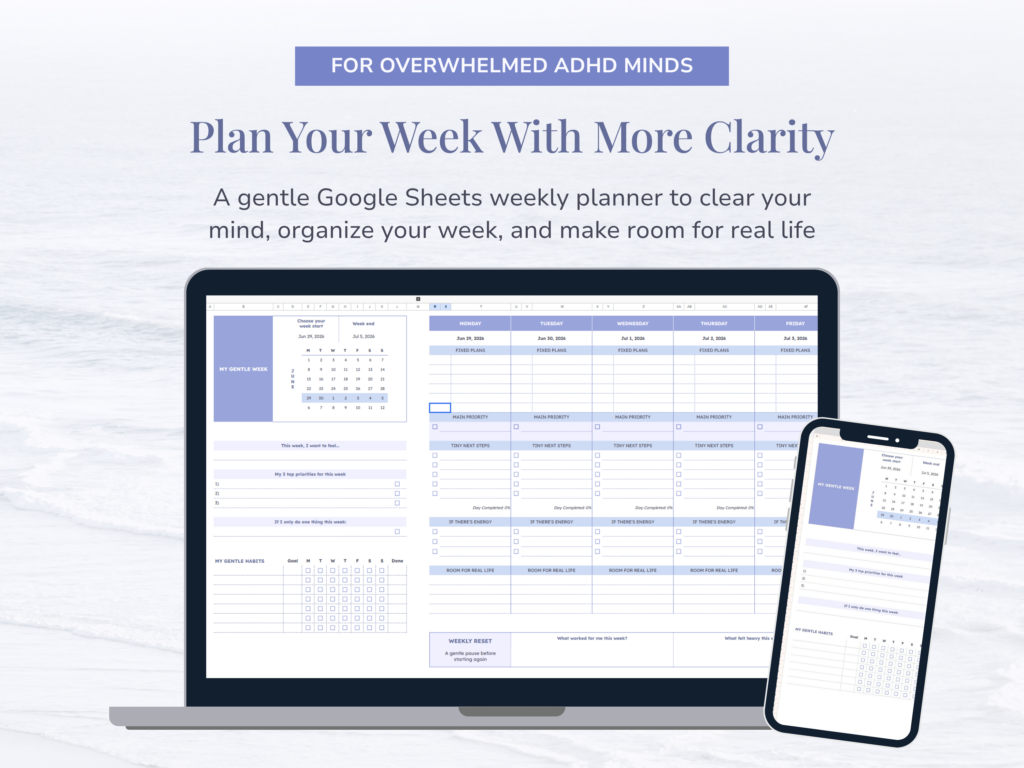
If you want to use this ADHD weekly planning method without building another system from scratch, the ADHD Weekly Planner Google Sheets was designed for exactly that.
It is a calm, one-tab weekly planning space for overwhelmed minds who need structure without pressure.
Instead of trying to hold every task, reminder, appointment, idea, and unfinished thing in your head, this planner helps you gently sort your week before jumping into action.
You can use it to clear your mind, choose what actually belongs in your week, plan around fixed appointments, pick one main priority per day, break bigger tasks into tiny next steps, and make room for real life.
Because real life is part of the plan.
Low energy counts.
Delays count.
Family life counts.
Transitions count.
Rest counts.
The random “I thought this would take 20 minutes and it took three hours” situation also counts. Rude, but common.
This Google Sheets ADHD week planner includes a brain dump section, weekly priorities, a week-at-a-glance view, fixed plans, tiny next steps, optional tasks, a gentle habit tracker, and a weekly reset section to help you carry the thread from one week to the next.
It is not a complicated productivity dashboard.
It is a gentle weekly planning system designed to help you stop starting from scratch every Monday and create a realistic week before trying to make it productive.
You do not need to fill in every box.
You do not need to use it perfectly.
You do not need to turn planning into another task you feel behind on.
Use what helps. Leave what does not. Come back when you lose the thread.
That is the whole point.
Final thoughts: you do not need a fresh start every Monday
You do not need to restart your life every week. You do not need a brand-new system every Sunday night. You do not need to punish yourself for unfinished tasks. You do not need to pretend that a blank page means a blank brain.
Your week is allowed to have loose ends. Your planner can help you carry them gently instead of letting them pile up in your head. Look back. Notice what is still open. Choose what matters. Make it smaller. Park what can wait. Let go of what no longer needs to follow you.
That is ADHD weekly planning with continuity. Not perfect planning. Human planning. A good ADHD weekly planner does not ask you to start from scratch every Monday. It helps you keep the thread.
And if you want a simple place to practice this, the ADHD Weekly Planner Google Sheets was created to help you clear your mind, plan your week realistically, and carry unfinished tasks forward without turning them into guilt.
Planning does not need to feel like a full life reset. Sometimes, it just needs to help you continue.