

Monthly Reset Routine: 4 ADHD-Friendly Steps When You Feel Behind
19 June 2026
Have you ever looked at the calendar and realized you’re only a week or two into the month… but you already feel behind? This is exactly when a monthly reset routine can help — not the dramatic, “change your whole life” kind, but a gentle reset that helps you pause, clear your head, and choose where to focus next.
Your goals are slipping. Your to-do list is growing. The motivation you had on the first day of the month is nowhere to be found. And suddenly you’re thinking: “Well, this month is ruined anyway.”
If you’ve ever had that thought, you’re not alone. I seem to have that experience almost every month. I start the month feeling unstoppable. This is going to be my month. I’m going to get organized. Stay consistent. Make progress on all my goals.
And then real life happens. The excitement fades. Unexpected things come up. My energy changes. And before I know it, I’m looking at my plans wondering how I got off track so quickly.
For a long time, I thought the solution was to try harder. Now I think the solution is something very different: a gentler monthly reset routine that helps you simplify instead of starting over completely.
In this article
Feeling Behind Doesn’t Mean You’re Failing
One thing I’ve noticed is that ADHD and overwhelmed minds often confuse “not moving fast enough” with “not moving at all.” We set ambitious goals. We imagine massive progress. And when reality doesn’t match the picture in our head, we feel like we’re failing.
But often, that’s not true. What’s actually happening is that we’re making progress much more slowly than we expected. And because our expectations were unrealistic, we overlook the progress completely.
The problem isn’t always the month. Sometimes it’s the story we’re telling ourselves about the month.
If this sounds familiar, you might also like this post on how to start again when you’ve given up on your goals. It’s a gentle reminder that starting again doesn’t have to mean starting from zero.
The Monthly Reset Trap
When people talk about resetting their lives, the advice often sounds exciting. New routines. New habits. New goals. New mindset. A complete transformation.
YouTube is full of “glow up” videos and dramatic life resets. And honestly? I’m sure that works for some people. But for many ADHD brains, it’s a disaster waiting to happen. Because the reset itself becomes overwhelming.
Suddenly you’re trying to:
- wake up earlier
- exercise every day
- meal prep
- meditate
- declutter your house
- organize your finances
- start three new habits
All at once. The result? You spend more time planning your new life than actually living it.

Step 1: Get Everything Out of Your Head
When I genuinely need a reset, I don’t start by adding more. I start by emptying my head. I write everything down:
- Tasks.
- Projects.
- Worries.
- Ideas.
- Things I’ve been avoiding.
- Things I keep mentally carrying around.
Because when everything stays inside my head, it feels impossible to know where to start. A brain dump doesn’t solve the problem immediately. But it makes the problem visible. And visible problems are much easier to work with.
Take a notebook, a document, or a planner. Write down everything. Don’t organize it. Don’t prioritize it. Just capture it. The goal is not to create a perfect plan. The goal is to stop carrying everything mentally.
If your mind feels full, you can start with this post on how to brain dump when your mind feels overwhelmed.
Step 2: Stop Trying to Fix Everything
This is the hardest part of any monthly reset routine. After a brain dump, you’ll probably see dozens of things you want to improve. That’s normal.
The temptation is to tackle all of them. Don’t. Instead, ask yourself: “If I could only make progress in three areas this month, what would matter most?”
Not fifteen. Not ten. Three. Or even two. Because focus becomes possible when priorities become limited.
If you need help with this part, you can read how to set monthly priorities without overloading yourself. It goes deeper into choosing a realistic focus without turning your whole month into a pressure-filled plan.
Step 3: Choose Progress Over Perfection
One thing that constantly gets ADHD and overwhelmed minds into trouble is unrealistic expectations. We create plans for our most motivated selves. Then we judge ourselves when we can’t sustain that energy.
I’ve done this more times than I can count.
- I plan weeks that assume every task will take thirty minutes. In reality, some of them take three hours.
- I assume I’ll feel motivated every day. I don’t.
- I assume I’ll have perfect focus. I won’t.
The more realistic your expectations become, the more likely you are to follow through.
So instead of asking, “How can I catch up on everything?”, try asking: “What can I realistically move forward this month?” That question changes the energy completely.

Step 4: Start Smaller Than You Think You Need To
When you already feel behind, it’s tempting to respond by increasing pressure. But pressure rarely creates sustainable progress.
Instead of asking, “How can I catch up?”, try asking: “What is one thing I can move forward today?” One task. One phone call. One page. One decision. One tiny step.
Small progress repeated consistently creates far more change than occasional bursts of motivation.
This is what makes a monthly reset routine useful: it helps you stop waiting for the perfect fresh start and gives you a way to begin again from where you actually are.
Why Most ADHD Planning Systems Don’t Work
This might be controversial, but I think many planning systems marketed to ADHD people completely miss the point. They often contain:
- dozens of pages
- endless trackers
- complicated dashboards
- huge goal-setting systems
They’re supposed to reduce overwhelm. Yet they often create more of it.
The reality is that most ADHD and overwhelmed minds don’t need more information. They need more clarity. Less complexity. Fewer decisions. A simpler path forward.
A Monthly Reset System Designed for Real Life
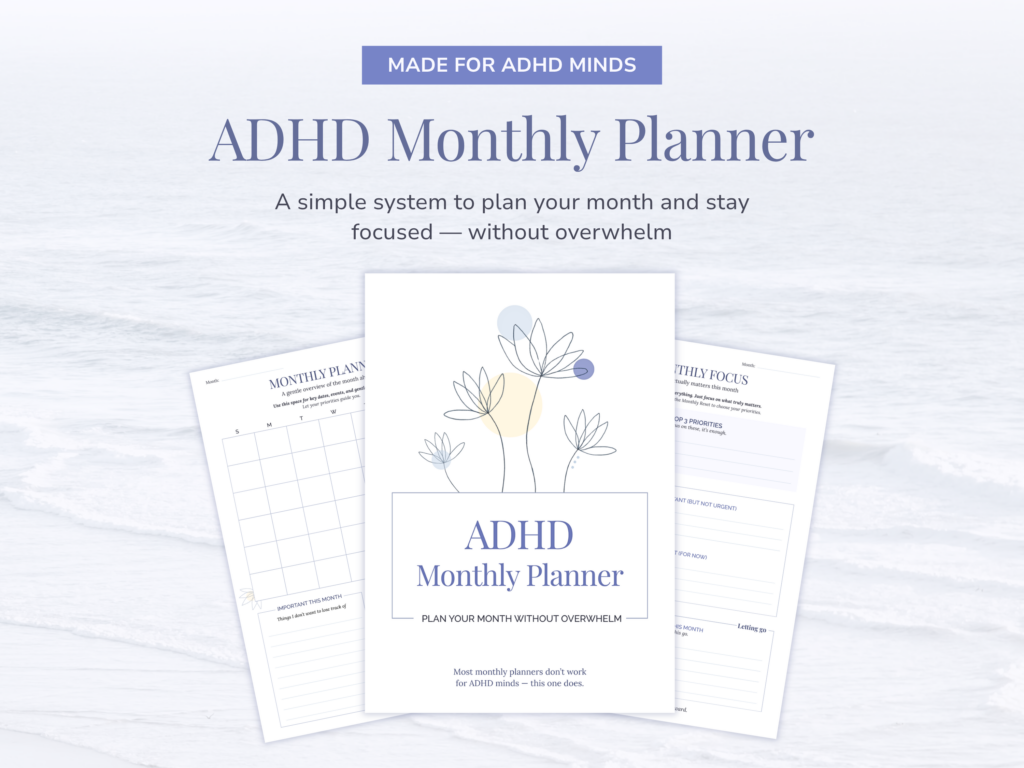
This idea is exactly why I created my ADHD Monthly Planner. Instead of forcing rigid planning, it helps you take a step back, clear mental clutter, identify realistic priorities, and organize your month in a way that actually feels manageable.
It was designed to support a gentle monthly reset routine without turning your life into a huge self-improvement project. The goal isn’t to become a completely different person by the end of the month. The goal is to create enough clarity to keep moving forward.
Even if progress is slow. Even if life feels messy. Even if you’re starting later than you hoped.
And if you’re not sure what kind of overwhelm is making it hardest to move forward right now, you can also take the free overwhelm quiz. It can help you understand what your brain might need before you try to plan more.
Final Thoughts
If you’re feeling behind this month, here’s something I want you to remember: You do not need to catch up on everything. You do not need a complete life makeover. You do not need to become a new person overnight. You just need a direction.
And one small step forward. Because moving slowly is still moving. And it is infinitely better than standing still because you tried to do too much at once.
The goal isn’t perfection. The goal is progress. Keep going.