

Why ADHD Time Management Feels So Hard — And What Actually Helps
3 July 2026
ADHD time management can feel impossible, even when you really want to be organized. You start the day with good intentions. You know what needs to get done. You tell yourself, “This should only take 20 minutes.”
And somehow, it is two hours later, you have opened seven tabs, half-started three tasks, moved a mug from one room to another, and now the whole day feels slightly broken. Very fun. Very normal. Very ADHD-coded.
The frustrating part is that ADHD time management is often treated like a discipline problem. As if you just need to try harder, wake up earlier, use a stricter planner, or finally become the kind of person who naturally follows a perfect schedule.
But for ADHD and overwhelmed minds, time is not always easy to feel. It can feel vague, stretchy, invisible… until suddenly it becomes very urgent.
That is why traditional time management systems often fail. They expect your brain to move through the day in a neat, predictable way.
But ADHD time management usually needs something softer. Not more pressure. More anchors.
In this article
Why ADHD Time Management Feels So Hard
One of the biggest reasons ADHD time management feels difficult is that time can be hard to estimate.
- A task that looks quick can take an hour.
- A task that looks huge can actually take eight minutes.
- A “quick break” can accidentally become 45 minutes of scrolling, reorganizing, or researching something you absolutely did not need to research today.
This makes daily planning tricky because you are not only deciding what to do. You are also trying to guess:
- How long will this take?
- How much energy do I have?
- What needs to happen first?
- What if I get interrupted?
- What if I forget the plan exists?
That is a lot of invisible work before you even start.
This is also why a strict daily schedule can feel good at first, then collapse very quickly. If you want a softer way to structure your day, you may also like ADHD Daily Schedule: How to Plan Your Day Without Overloading Yourself.
The Problem with Rigid Time Management
A lot of time management advice sounds helpful in theory.
- Plan every hour.
- Batch your tasks.
- Stick to the schedule.
- Be consistent.
Cute. But ADHD time management does not usually improve just because the plan is stricter. Actually, a rigid plan can make the day feel worse.
- You planned laundry at 9:00.
- Emails at 9:30.
- Work at 10:00.
But laundry took longer, the email was stressful, and now it is 10:47. So your brain says: “Well. The plan is dead. We live in chaos now.” This is the problem with rigid schedules: one delay can make the whole day feel ruined.
ADHD time management needs flexibility. Not zero structure. Not complete chaos. But enough room for real life, fluctuating energy, transitions, interruptions, and the fact that some days your brain is buffering like an old laptop.

What Actually Helps ADHD Time Management
Instead of trying to control every minute, ADHD time management often works better with daily anchors. A daily anchor is not a strict schedule. It is a point of support.
It helps you decide what matters today, what your brain needs, and what you can come back to when you start drifting. Think of it less like a military timetable and more like a soft handrail for your day.
A helpful daily anchor can include:
- one main focus;
- up to three realistic priorities;
- tiny steps for tasks that feel too big;
- supportive time anchors;
- dopamine breaks;
- a place to unload mental noise;
- a simple overwhelm plan.
The goal is not to plan the perfect day. The goal is to make the day easier to enter.
If your biggest struggle is starting tasks once you know what needs to happen, you may also like How to Start a Task When Your Brain Says “Not Now”.
Start with One Main Focus
One of the simplest ways to support ADHD time management is to choose one main focus for the day.
Not twelve. Not a complete life reset. Not the fantasy version of you who wakes up early, drinks lemon water, answers every email, and becomes a productivity icon before breakfast.
One. Your main focus is the thing you want the day to gently revolve around. It might be:
- “Finish the client draft.”
- “Reset the kitchen.”
- “Handle the appointment.”
- “Make progress on the product page.”
- “Rest and recover.”
This gives your day a center. It does not mean nothing else can happen. It simply gives your brain something to return to when everything starts feeling equally important.
And that matters, because ADHD time management becomes much harder when every task looks urgent at the same time.
I talk more about this in Why ADHD Organization Fails When Everything Is Treated the Same Way, because one big problem with many planning systems is that they treat every task as if it needs the same kind of attention.
Choose Fewer Priorities
Another ADHD time management shift that helps: choose fewer priorities on purpose.
Many overwhelmed minds plan from panic. You feel behind, so you write everything down. Then the list becomes huge. Then the huge list feels impossible. Then your brain avoids the list entirely. Very efficient. Horrible, but efficient.
Instead, try choosing up to three priorities for the day. Three is enough to create direction, but not so many that your brain immediately wants to leave the building.
Your priorities do not have to be impressive. They have to be realistic. For example:
- send the form;
- fold one laundry basket;
- prep tomorrow’s appointment.
That is a real day. ADHD time management works better when your plan matches your actual capacity, not your ideal one.

For weekly planning, the same idea applies. You can read The ADHD Weekly Planning Method That Takes Less Than 10 Minutes if you want a simple way to plan your week without overloading yourself.
Use Time Anchors Instead of a Perfect Schedule
If hour-by-hour planning makes you feel trapped, try using time anchors instead. A time anchor is a loose point in the day that helps you create rhythm without controlling everything. For example:
- Morning anchor: choose your focus and priorities.
- Midday anchor: eat, reset, and choose the next tiny step.
- Afternoon anchor: make progress on one important thing.
- Evening anchor: unload anything still floating in your brain.
This gives your day shape without demanding perfection. You are not saying: “At exactly 10:00, I must do this.” You are saying: “During this part of the day, I come back to what matters.”
That small shift can make ADHD time management feel much less heavy.
Add Dopamine Breaks on Purpose
A lot of time management systems forget that ADHD brains need interest, movement, novelty, and reward. If your plan is only tasks, tasks, tasks, your brain may rebel.
A dopamine break is a small, intentional pause that helps your brain stay engaged. It could be:
- stepping outside;
- making a fun drink;
- listening to one song;
- stretching;
- doing something with your hands;
- texting a friend.
The key is to plan the break before your brain steals one. Because when breaks are not intentional, they can turn into accidental escape tunnels. One quick scroll becomes 45 minutes. One tiny distraction becomes a full side quest.
Dopamine breaks make ADHD time management more realistic because they support your brain instead of pretending it is a machine.
Make an Overwhelm Plan
One of the most helpful ADHD time management tools is an overwhelm plan. Because overwhelm will probably show up at some point. Not because you are failing. Because you are human.
And when you are already overwhelmed, it is very hard to make calm decisions. So decide in advance what you will do when the day starts to feel too much.
Your overwhelm plan can be simple:
- Pause.
- Drink water.
- Brain dump what is spinning.
- Choose one tiny next step.
- Let one thing wait.
You do not need to rescue the whole day. You only need a way back in.
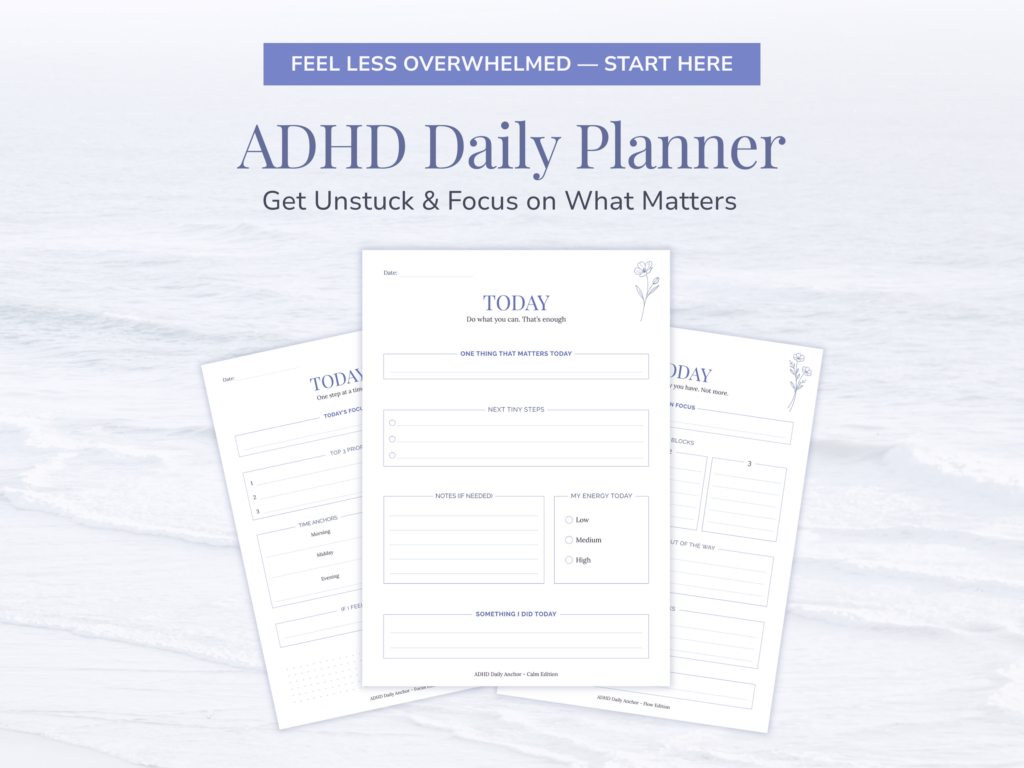
This is one of the reasons I created ADHD Daily Anchors. It gives you a gentle daily page to check in with your energy, unload mental noise, choose what matters, add supportive time anchors, and decide what to do if overwhelm appears. Not to control your day. To support it.
Final Thoughts on ADHD Time Management
ADHD time management feels hard because time can be difficult to feel, tasks can be hard to estimate, and rigid plans often break the moment real life enters the chat.
So if traditional time management has not worked for you, it does not mean you are lazy, messy, or broken. It may simply mean your brain needs a different kind of support. Less pressure. More anchors.
You do not need to master the whole day at once. You can start with one main focus, three realistic priorities, tiny steps, time anchors, dopamine breaks, and a simple plan for overwhelm.
The ADHD Daily Anchors page was designed for exactly that: a gentle daily page to help ADHD and overwhelmed minds feel grounded, focused, and supported throughout the day.
Not a rigid daily planner. A soft place to return to. You use the energy you have, one step at a time. And that is enough.
And if you are not sure what kind of planning support your brain needs right now, you can also take the ADHD Anti-Overwhelm Quiz.