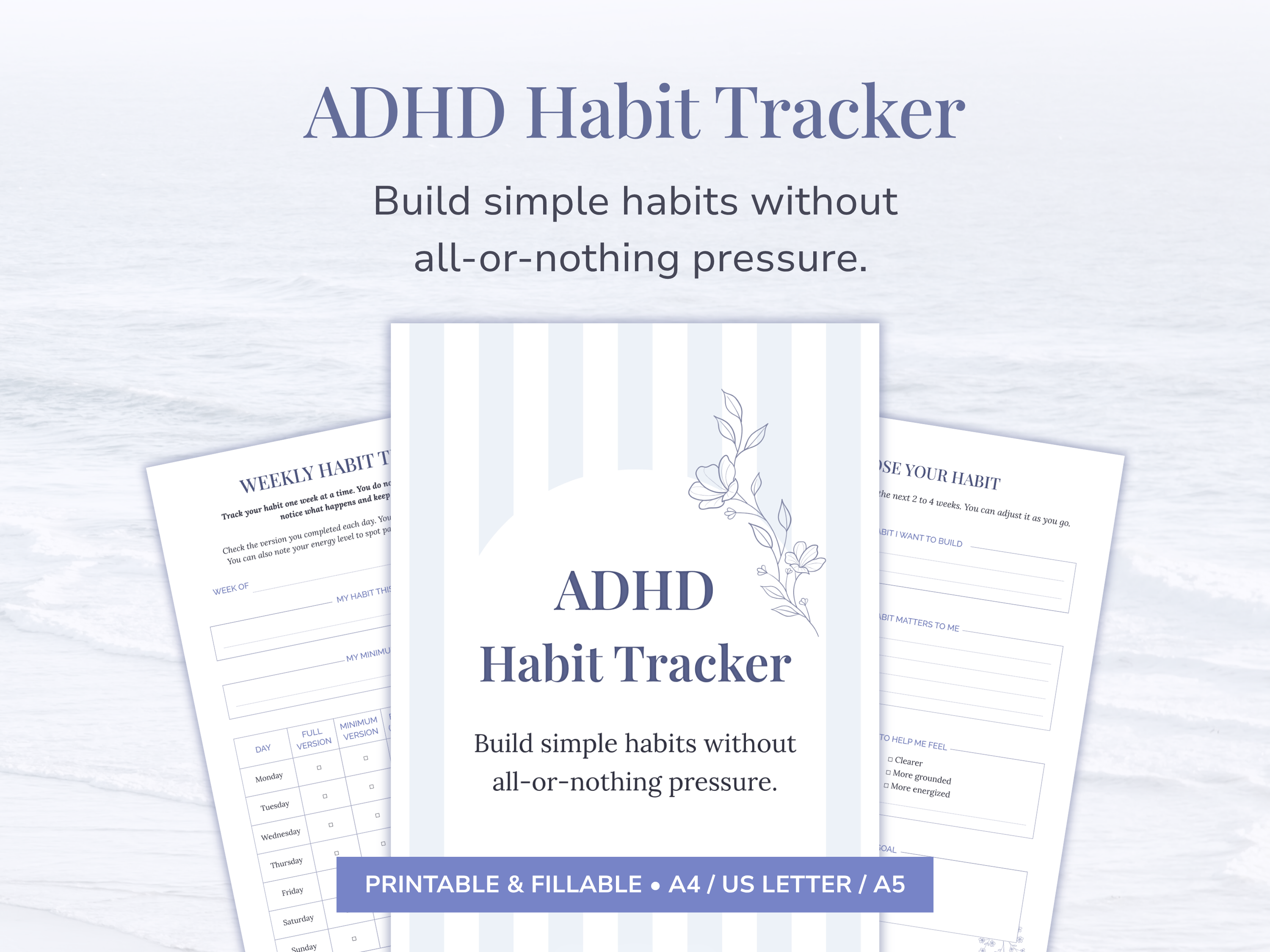

ADHD Habit Tracker: 7 Easy Steps to Build Habits Without Overwhelm
17 July 2026
An ADHD habit tracker can be really helpful when you want to build routines, but only if it is simple enough to use on real-life days. Not the imaginary version of your life where you wake up refreshed, drink water, stretch, journal, answer emails, meal prep, clean the kitchen, remember every appointment, and somehow still have a regulated nervous system by 9 a.m.
The real version. The one where you start a new habit with good intentions, forget about it three days later, feel guilty, and then decide that maybe you are simply “bad at habits.”
But the problem is often not you. Sometimes the habit is too big. Sometimes the routine is too vague. Sometimes the tracker is too strict. And sometimes one missed day makes the whole thing feel ruined.
That is why a gentle ADHD habit tracker should not be about perfect streaks or becoming a brand-new person by Monday. It should help you choose one realistic habit, make it easier to start, track your progress without shame, and restart when life gets messy.
Here is how to use an ADHD-friendly habit tracker in a way that actually works with your brain.
In this article
1) Start with one habit, not a whole life makeover
The fastest way to make a habit tracker overwhelming is to fill it with 17 habits on day one.
- Drink water.
- Stretch.
- Walk.
- Read.
- Journal.
- Take vitamins.
- Meditate.
- Clean.
- Sleep earlier.
- Stop scrolling.
- Become an emotionally stable forest fairy.
Very cute. Completely exhausting.
When you are using an ADHD habit tracker, the goal is not to track everything you could possibly improve. The goal is to choose one habit that would make your life feel a little easier. Just one.
For example:
- drink one glass of water in the morning
- take your vitamins after breakfast
- check your planner once a day
- tidy one tiny area
- journal for two minutes
- stretch before bed
- put your keys in the same place
This is exactly why the ADHD Habit Tracker I created starts by helping you choose one habit to focus on. Not a full personality transplant. One small habit that feels realistic enough to come back to. Because with ADHD, “small enough to start” is usually more useful than “impressive enough to brag about.”
If choosing what matters most already feels overwhelming, you may also like How to Plan Your Day with ADHD Without Creating a Rigid Schedule. It can help you turn scattered priorities into a softer, more realistic plan.
2) Make the habit ridiculously clear
A vague habit is very easy to avoid. “Move more” sounds nice, but what does it actually mean? Walk? Stretch? Dance in the kitchen? Do one squat and call it wellness?
Your brain needs a clear action.
- Instead of: “I want to drink more water.” Try: “I will drink one glass of water after brushing my teeth.”
- Instead of: “I want to be more organized.” Try: “I will check my planner after breakfast.”
- Instead of: “I want to tidy more.” Try: “I will clear one surface before lunch.”
A good ADHD habit tracker should help you turn vague intentions into tiny, concrete actions. This matters because ADHD brains often struggle less with wanting the result and more with knowing where to begin.
And when the habit is clear, the checkbox becomes less threatening. It is not asking you to “be better.” It is asking you to do one specific thing. Much nicer. Less emotionally dramatic. We appreciate that.

3) Create a low-energy version before you need it
This step is so important. Most habit plans are made by the motivated version of you. The one who has slept well, had coffee, found a nice pen, and believes deeply in her own transformation. Lovely woman. Cannot always be trusted.
Because real life includes tired days, chaotic days, parenting days, work days, “why is everyone asking me questions” days, and days where even opening the tracker feels like a bit much.
That is why your habit needs a low-energy backup version.
For example:
- Main habit: “Journal for 10 minutes.” Low-energy version: “Write one sentence.”
- Main habit: “Go for a 30-minute walk.” Low-energy version: “Put on shoes and step outside for two minutes.”
- Main habit: “Clean the kitchen.” Low-energy version: “Put five things away.”
- Main habit: “Drink 2 liters of water.” Low-energy version: “Drink one glass.”
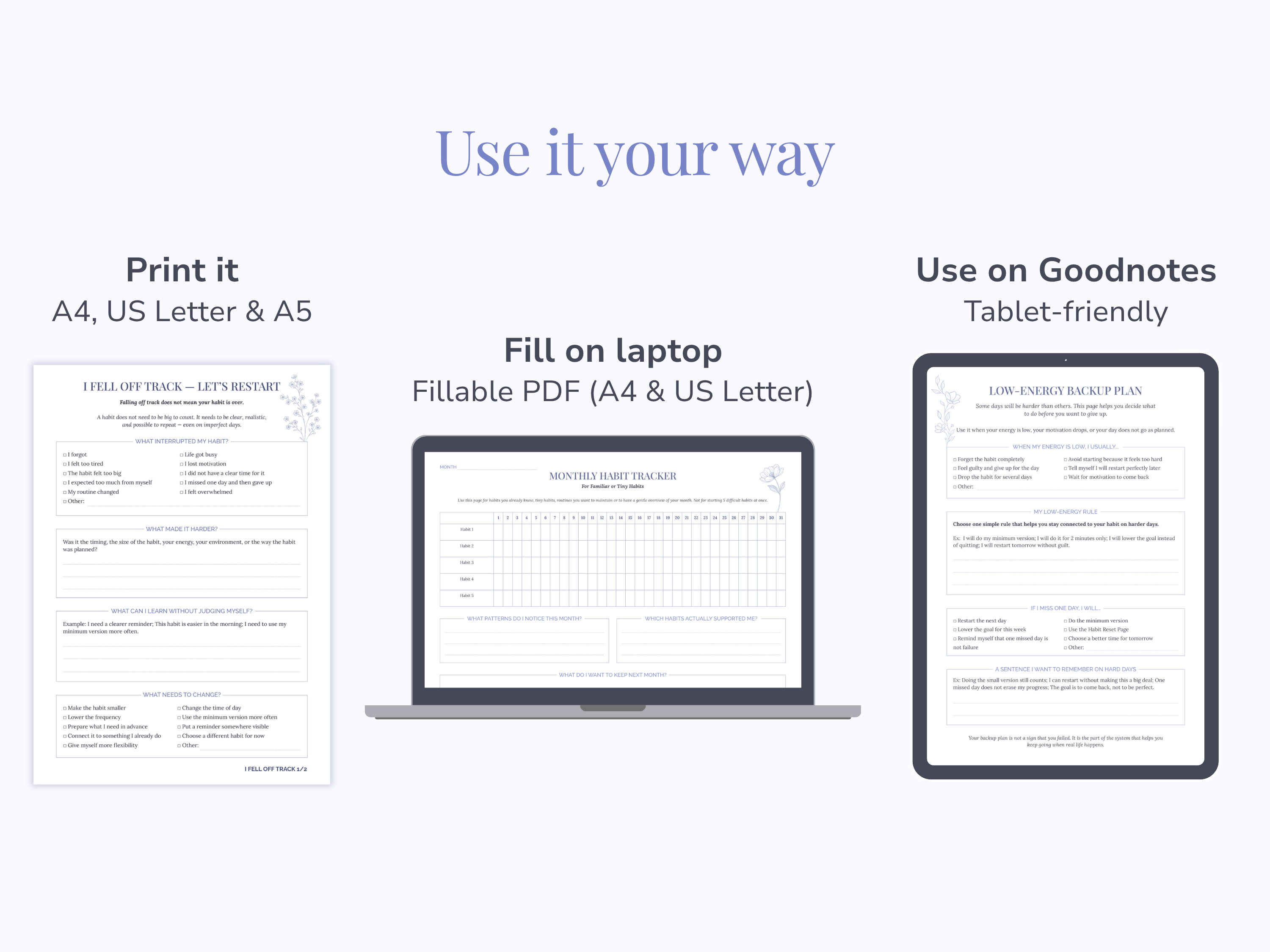
This is one of the pages included in the ADHD Habit Tracker because it helps you avoid the all-or-nothing trap.
You are not failing because you did the tiny version. You are keeping the habit alive. And honestly, for ADHD and overwhelmed minds, that is already a big deal.
If getting started is usually the hardest part, you can also read How to Start a Task When Your Brain Says “Not Now”. It goes deeper into making the first step feel less impossible.
4) Use reminders that are already connected to your life
A habit is easier to remember when it is attached to something that already happens. This is sometimes called habit stacking, but you do not need to make it complicated.
You simply choose an existing anchor:
- After I brush my teeth, I will drink water.
- After I make coffee, I will take my vitamins.
- After I close my laptop, I will tidy my desk for two minutes.
- After dinner, I will check tomorrow’s appointments.
- Before I get into bed, I will write one sentence.
The reminder does not have to be perfect. It just needs to be visible enough for your brain to catch it. You can also use:
- sticky notes
- phone reminders
- alarms
- planner notes
- objects placed in obvious locations
- a printed habit tracker on your desk, fridge, or bedside table
This is where a printable ADHD habit tracker can be especially helpful. When your tracker is visible, the habit is less likely to disappear into the mysterious fog where forgotten tasks go to live.
The ADHD Habit Tracker Printable & Fillable PDF includes space to set up simple reminders, because “I’ll just remember” is a beautiful idea, but for many ADHD brains, it is also comedy.
5) Track progress weekly instead of chasing perfect streaks
Traditional habit trackers often focus on streaks. And streaks can be motivating for some people. But for ADHD brains, they can also become weirdly intense.
You miss one day. The streak is broken. The page looks “ruined.” Your brain decides the whole habit is dead. Everyone goes home. This is why an ADHD habit tracker works better when it focuses on progress, not perfection.
Instead of asking, “Did I do this every single day perfectly?” ask:
- Did I come back to it?
- Did I learn what makes it easier?
- Did I notice what gets in the way?
- Did I do the low-energy version?
- Did this habit feel realistic this week?
A weekly habit tracker gives you enough structure to notice patterns, but not so much pressure that one missed day feels like a personal failure.
In the ADHD Habit Tracker I created, you get weekly tracking pages so you can follow your habit gently, reflect without judging yourself, and restart when needed.
Because the goal is not a perfect row of checkboxes. The goal is building trust with yourself again.
For a softer weekly structure, you may also like The ADHD Weekly Planning Method That Takes Less Than 10 Minutes. It can help you plan your week without turning it into a second full-time job.
6) Review your habit without turning it into a self-roast
Reflection is useful. Shaming yourself is not. There is a difference between: “I missed three days because I am terrible at consistency.” And: “I missed three days because I put the tracker in a drawer, chose a habit that was too big, and forgot to connect it to a reminder.”
One gives you guilt. The other gives you information.
When you use an ADHD habit tracker, try to review your week like a detective, not like a disappointed life coach with a clipboard. Ask yourself:
- What made this habit easier?
- What made it harder?
- Was the habit too big?
- Did I forget it?
- Did I need a clearer reminder?
- Would a smaller version help?
- Do I actually care about this habit, or did I choose it because I thought I “should”?
This kind of reflection helps you adjust the system instead of attacking yourself. And that is very much the point of this ADHD habit planner: it gives you space to notice what happened without making the tracker feel like evidence against you. No guilt spiral required.

7) Restart before you feel ready
This might be the most ADHD-friendly habit rule: You do not need to wait for a new week, a new month, a new planner, a new personality, or a dramatic “this time I’m serious” moment. You can restart today.
Actually, you can restart badly today:
- You can restart with the tiny version.
- You can restart after missing five days.
- You can restart with one checkbox.
- You can restart while tired, messy, annoyed, and not particularly inspired.
A helpful ADHD habit tracker should make restarting feel normal, not embarrassing. Because falling off track is not the opposite of building a habit. It is part of building a habit.
The real skill is not “never missing a day.” The real skill is learning how to come back without turning it into a whole identity crisis.
That is why the ADHD Habit Tracker I created includes restart-friendly pages. It helps you look at what happened, simplify the habit, choose your next tiny step, and keep going without needing a perfect fresh start. No dramatic reset montage necessary.
And if you are already feeling behind before you even start again, How to Reset Your Month When You Already Feel Behind can help you create a gentler reset without trying to fix your whole life in one afternoon.
Why an ADHD habit tracker can work better than a regular habit tracker
A regular habit tracker often assumes that consistency is the main goal. But for ADHD and overwhelmed minds, flexibility matters just as much. You may need:
- smaller habits
- clearer reminders
- low-energy versions
- weekly and monthly views
- room to restart
- less pressure around missed days
- a tracker that does not ask you to manage 27 habits at once
That is why an ADHD habit tracker should feel less like a performance chart and more like a support tool. It should help you ask: “What is the smallest habit that would help me right now?” Not: “How can I rebuild my entire life before Sunday?”
This ADHD Habit Tracker was designed for exactly that. It includes printable PDF formats in A4, US Letter, and A5, plus fillable PDF formats in A4 and A5, so you can use it in the way that feels easiest for you. You can print it at home, keep it in a binder, fill it on your computer, or use it on a tablet with apps like GoodNotes, Notability, Xodo, or other PDF annotation apps.
The format is flexible because your brain and your life are allowed to be flexible too.
Habit ideas to track when you have ADHD
The best habit to track is not always the most impressive one. It is usually the one that removes a little friction from your daily life. Here are some ADHD-friendly habit ideas:
- drink one glass of water
- take vitamins or medication
- check your planner
- make your bed
- tidy one small area
- write one sentence
- go outside for two minutes
- stretch before bed
- prepare clothes for tomorrow
- reduce evening scrolling
- do a two-minute reset
- empty your bag
- start a simple morning routine
- create a calming evening routine
You can use an ADHD habit tracker for self-care habits, home habits, wellness routines, planning habits, or tiny maintenance habits that help life feel a little less chaotic. The key is to choose something that is small enough to repeat, not something that sounds impressive but secretly requires the energy of a full moon ritual and three coffees.
A gentle way to build habits with ADHD
Building habits with ADHD is not about forcing yourself into a perfect routine. It is about making the habit easier to notice, easier to start, and easier to come back to.
A good ADHD habit tracker can help you do that by giving your habit a place to live outside your head. It can help you choose one focus, make it smaller, create a low-energy version, set up reminders, track progress, reflect gently, and restart without guilt.
That is the whole idea behind the ADHD Habit Tracker I created. It is not a complicated productivity dashboard. It is not a “fix your whole life” system. It is not here to judge your empty checkboxes from across the room.
It is a gentle habit planner for ADHD and overwhelmed minds who want to build simple routines without all-or-nothing pressure. One habit. One tiny step. One restart at a time.